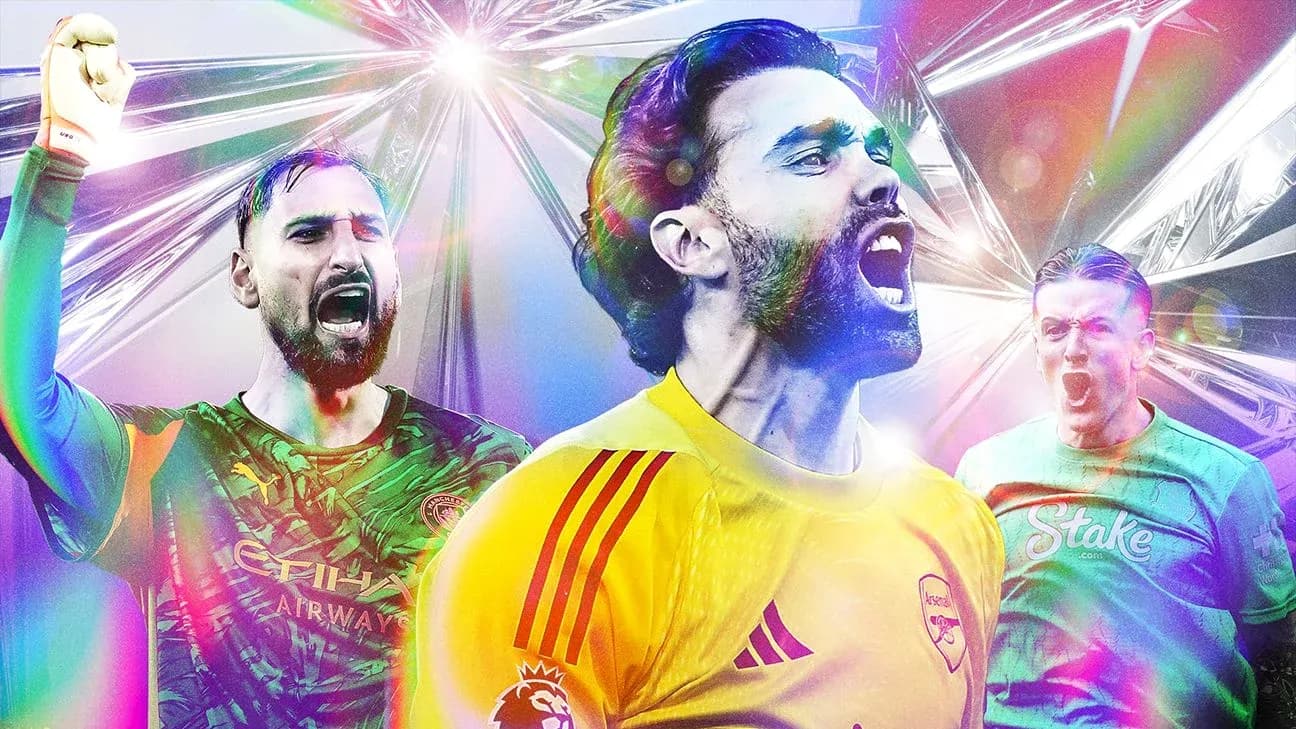
What Makes a Goalkeeper World-Class?
What turns a good goalkeeper into a world-class one? Reflexes matter, of course. So does presence. But in 2026, the job has become something else entirely. Keepers are playmakers, sweepers, psychologists, and, when it all comes down to penalties, cold-blooded gamblers.
These 10 have lived under that pressure over the past year and thrived. Some are legends, some are late bloomers, others are still climbing. All of them belong in the FC 100.
10. Matvey Safonov (Paris Saint-Germain/Russia, 27)
Safonov doesn’t just save penalties; he owns shootouts. Four stops from five against Flamengo to win the Intercontinental Cup for PSG is the sort of night that follows a goalkeeper for the rest of his career.
He arrived in Paris as a question mark, especially after Gianluigi Donnarumma’s exit. Then PSG spent €50 million on Lucas Chevalier, the outstanding keeper in Ligue 1 at the time, and parked Safonov on the bench to start 2025-26. That could have buried him.
Instead, he convinced Luis Enrique in training, took the gloves, and never looked back.
Eight shutouts in 15 league games – a 53.3% clean-sheet rate, the best in Ligue 1 among keepers with at least 15 appearances – underlined his reliability. In the Champions League knockout rounds, away at Liverpool, Bayern Munich and Chelsea, he did exactly what PSG needed: no drama, no errors, just the saves that had to be made.
He’s not the most spectacular shot stopper in the world, nor the most gifted with the ball at his feet. But he grew into the role of PSG’s No. 1 in a season of enormous pressure and delivered.
Now comes the harsh part. PSG are still looking at other goalkeepers this summer. His status is under threat again. Safonov will have to repeat the same trick: prove people wrong, from the moment pre-season starts.
9. Jordan Pickford (Everton/England, 32)
Jordan Pickford is not just a goalkeeper at Everton; he’s an icon on the terraces. The fans sing about him being “dynamite,” and the description fits.
Since joining from Sunderland in 2017, he has been Everton’s constant. Last season he played every single Premier League game under David Moyes, producing a catalogue of big saves that had the club flirting with European qualification before their campaign faded late on.
His 11 shutouts were tied for the third most in the Premier League, behind only David Raya (19) and Gianluigi Donnarumma (15). That consistency kept Everton in the conversation near the top half for much of the year.
For England, he remains Gareth Southgate’s trusted No. 1. He started all but one of England’s World Cup matches in the summer. The criticism always comes with him – it always has – but his performance in the 3-2 win over Mexico at the Azteca, in a cauldron of noise and hostility, reminded everyone why managers keep picking him.
Pickford has committed his future to Everton with a contract running to at least 2029. The targets are clear: drag the club into Europe and give the fans a serious cup run, while keeping his grip on the England shirt in the face of rising competition.
8. Diogo Costa (FC Porto/Portugal, 26)
Diogo Costa has been on the radar for years. Now he looks ready to jump.
He first appeared around Porto’s first team in 2019, but his real breakthrough came in 2021 when he took over from the injured Agustin Marchesin. From there, his progress has been relentless.
Costa is one of the most intelligent “sweeper keepers” in the game. Calm, economical, and always a step ahead, he launches attacks with his feet or his throws, breaking presses with passes that take out entire lines. His reading of the game in possession is elite.
The numbers match the eye test. In 2025-26 he posted a 79.7% save percentage and conceded just 0.46 goals per 90 minutes as Porto collected yet another Primeira Liga title. He became the first goalkeeper since 2022-23 to register 20 or more shutouts in a league season in Portugal.
His one lingering question mark has been pure shot-stopping, which has hovered around 70% across his career, but that too is trending upwards. At 26, turning 27 next month, he is still years away from his theoretical peak.
Portugal’s World Cup ended in the round of 16 against Spain, but Costa’s stock rose regardless. Chelsea have tracked him, with Xabi Alonso keen on an upgrade in goal, and Manchester United have circled in previous windows. Porto, though, will demand a major fee before they let their No. 1 go.
Until a serious bid lands, Costa prepares for another season with Champions League football – and another chance to show he’s outgrown the Portuguese league.
7. Alisson (Liverpool/Brazil, 33)
Alisson’s aura hasn’t disappeared. It has just been interrupted.
Last season was difficult for both Liverpool and their Brazilian No. 1. Muscle injuries kept him sidelined for spells, which inevitably drags him down this ranking, but when he plays, the class is still obvious.
At 33, he remains one of the best one-on-one goalkeepers in the world. His 6-foot-4 frame, immaculate positioning and timing in the duel make forwards hesitate, then snatch at chances. There is a reason he kept the Brazil No. 1 shirt at the World Cup, adding two more shutouts to take his career total at the tournament to seven – the third most by a Brazilian goalkeeper in the past 60 years.
Liverpool have had to manage his fitness carefully, yet whenever he is fully fit, he transforms their defensive stability. He is a leader in the dressing room and a safety net for an aggressive, front-foot team.
Juventus showed interest this summer, sensing a possible opening as his contract wound down. Liverpool shut that down. They want him for the final year of his deal. If this is to be his Anfield farewell, Alisson will aim to leave with one more major trophy and his reputation as a club legend untouched.
6. Emiliano Martínez (Aston Villa/Argentina, 33)
Some goalkeepers keep you calm. Emiliano Martínez does the opposite. He drags everyone into his drama.
The Aston Villa and Argentina keeper has that rare X factor. He doesn’t just participate in big games; he bends them to his will. Last season with Villa, he helped drive them to fourth place in the Premier League and into the Champions League. Then he went and won the Europa League, keeping a clean sheet in a 3-0 final win over Freiburg despite breaking a finger in the warmup.
That detail sums him up. He thrives on chaos.
Across the campaign he produced outrageous saves and a few outrageous errors, too. One pass in the buildup to a goal against Lille was so audacious that his teammates mobbed him instead of the scorer, John McGinn.
He carried that form, and that fractured finger, into the 2026 World Cup. Argentina reached the final. Martínez made 11 saves in that game – the most in a World Cup final in the past 60 years and tied for the second-most in any men’s World Cup knockout match in that span, behind only Tim Howard’s famous 15 for the U.S. in 2014. Spain eventually broke through, but Martínez kept them out for as long as humanly possible.
How many goalkeepers can say they outshone Lionel Messi in a World Cup final? This one can.
Juventus’ interest has cooled for now, so another season with Villa in the Champions League awaits. Martínez will relish every second.
5. Joan García (Barcelona/Spain, 25)
Joan García walked into one of the most scrutinised positions in football and made Barcelona look safer overnight.
His €25 million move across the city from Espanyol was controversial, but the impact was instant. Barcelona’s high defensive line often leaves their goalkeeper exposed. García responded by turning into a shot-stopping wall.
He conceded just 21 goals in 30 LaLiga games, the fewest in Europe’s big five leagues among keepers with 30 or more matches. He kept 15 clean sheets and posted a league-best goals prevented (GPrv) figure of 10.72, ahead of Getafe’s David Soria (9.03). When Wojciech Szczęsny played eight league games, Barça conceded 15 goals. The contrast was stark.
Several performances were worth points on their own. Twice against Rayo Vallecano, and especially away at Espanyol, where his save from Pere Milla – later voted LaLiga’s Save of the Season – was as much about nerve as technique.
His form forced Marc-André ter Stegen out on loan to Ajax for 2026-27. García is now firmly Barça’s No. 1. The next step is to transfer that domestic dominance to the Champions League, where he has been solid rather than spectacular so far.
For Spain, the battle is even tougher. Unai Simón just helped deliver a second World Cup for La Roja. García looks like the heir, but he may have to wait and fight through another cycle before he finally pulls on the national team’s No. 1 shirt.
4. Unai Simón (Athletic Club/Spain, 29)
On league form alone, Unai Simón wouldn’t be this high. On legacy, he has to be.
Athletic Club’s 2025-26 LaLiga campaign was underwhelming, and Simón’s own performances were, at times, ordinary. But what he did for Spain this summer changed everything.
He conceded just one goal in eight World Cup matches, set a record 649 consecutive minutes without conceding in the tournament – breaking Walter Zenga’s 517-minute mark from 1990 – and left with the Golden Glove and a winner’s medal. In the semifinal against France, he made three crucial late saves as the pressure rose. When Spain needed calm, he supplied it.
Luis de la Fuente was criticised for sticking with Simón ahead of David Raya and Joan García. The coach’s faith in his leadership and composure under pressure was vindicated in the most emphatic way possible. Add this World Cup to the European Championship he won two years earlier, and Simón has built a résumé that puts him among Spain’s all-time greats in goal, even if he might not be the most talented Spanish keeper in club football right now.
Back in Bilbao, the target is clear: improve on last season’s 12th-place finish under new coach Edin Terzic. With no European football as a distraction after a bruising Champions League campaign, Athletic can focus on the league.
For Spain, the fight starts again in the Nations League, with Raya and García both pushing. De la Fuente must decide whether to stay loyal to his World Cup winner or usher in a new era.
3. Gianluigi Donnarumma (Manchester City/Italy, 27)
Gianluigi Donnarumma knows what it feels like to win the Champions League and then be told he’s no longer needed.
After helping PSG lift the trophy in 2025, he found himself surplus to requirements in Paris. Manchester City seized the opportunity, bringing in a 6-foot-5 shot-stopping machine whose weaknesses with the ball at his feet have long been debated.
The Premier League posed fresh questions. Donnarumma answered most of them. He won the internal battle with James Trafford to become City’s No. 1 and delivered 15 clean sheets in 34 league games – a 44% shutout rate, the best of his career and second only to David Raya’s 51% among keepers who played more than once.
He produced spectacular saves throughout the campaign, helping City push for a final title under Pep Guardiola. The doubts about his distribution haven’t vanished, but his raw shot-stopping remains arguably the best in the world.
Now Guardiola has gone and Enzo Maresca has arrived. Donnarumma’s next challenge is to convince a new manager that he’s the long-term answer in a system that demands precision in possession.
On the international stage, the frustration lingers. Italy missed a third straight World Cup this summer. Donnarumma, still only 27, will be desperate to have a major tournament to define his national-team career in the way his club résumé already has.
2. Thibaut Courtois (Real Madrid/Belgium, 34)
Thibaut Courtois has built a career on looming over forwards and big occasions alike.
Real Madrid’s LaLiga season was disappointing as they finished well behind Barcelona, but their 6-foot-7 goalkeeper remained a pillar. He conceded 28 goals in 32 league games, with only Joan García posting a better goals-against average than Courtois’ 0.88. García was also the only keeper with more clean sheets in LaLiga than Courtois’ 13.
In Europe, he was just as sharp. An 81.5% save percentage in the Champions League, second only to David Raya, helped Madrid reach the quarterfinals.
Then came the World Cup, his first major international tournament since 2022. Belgium reached the quarterfinals and were level at 1-1 with eventual champions Spain when Courtois went off injured. His replacement, Senne Lammens, made a costly error, and Belgium went out. It was impossible not to wonder how the story would have changed if Courtois had stayed on.
Now Madrid turn to a new chapter under José Mourinho. Courtois has long wanted more defensive structure and discipline in front of him. Mourinho, along with heavy investment in the back line, should provide exactly that as the club tries to reclaim LaLiga.
For Belgium, Courtois has asked for a pause. After the World Cup, he said he would like to stay in Madrid during the Nations League and consider his future if the federation accepts that. A quieter international year might be exactly what he needs to extend his prime at club level.
1. David Raya (Arsenal/Spain, 30)
David Raya has gone from a transfer debate to the best goalkeeper in the world on current form.
When he arrived at Arsenal, the argument raged: was he really an upgrade on Aaron Ramsdale? Three years on, the numbers and the trophies answer that question.
In 2025-26, Raya was central to Arsenal’s Premier League title win and their run to the Champions League final. He kept 19 clean sheets in the league, four more than any other goalkeeper, and claimed a third straight Golden Glove. Across all competitions, Arsenal recorded 32 shutouts, with Raya the commanding presence behind an outstanding defence.
His 48 Premier League clean sheets over the past three seasons are 12 more than any other goalkeeper. That consistency, in a league that punishes even minor lapses, is staggering.
Raya’s case to be considered the best in the world is strong. Yet for Spain at the World Cup, he didn’t play a single minute. Luis de la Fuente stuck with Unai Simón, and Spain lifted the trophy without calling on Arsenal’s No. 1.
Back in north London, the mission is clear. Arsenal’s success last season was built on being hard to beat more than on free-scoring football. Whether Mikel Arteta loosens the handbrake or not this year, having Raya behind his back line is a huge advantage.
Defend the Premier League. Chase the Champions League again. With this level of goalkeeping, Arsenal can think about doing both.