Germany's World Cup Preparations: Key Performances and Tactical Decisions
Kai Havertz walked off with a goal. Deniz Undav left with a storm. And somewhere between those two, Julian Nagelsmann’s World Cup plans took on a sharper, if more combustible, shape.
This Germany camp did not just produce winners and losers. It exposed fault lines, confirmed hierarchies and raised awkward questions the national coach can no longer talk away.
Wirtz takes the stage, Havertz keeps the role
The brightest light belonged to Florian Wirtz. In Switzerland, he delivered the kind of performance Germany have been waiting years to see from a playmaker in a national shirt. Nominally starting on the left, he drifted into the half-spaces, linked with Kai Havertz and Serge Gnabry, and dictated almost everything of value Germany did in attack.
He was directly involved in all four goals, scoring twice with that clean, effortless shooting technique that has become his trademark. It was not just numbers. It was authority. The game ran through him.
Nagelsmann’s tweak behind him was telling. Gnabry, used as a No. 10, repeatedly burst into the box with short, sharp sprints, dragging defenders away and clearing lanes for Wirtz to operate. The second goal against Switzerland was the blueprint: Gnabry’s movement, Wirtz’s freedom, chaos in the opposition back line. Against Ghana, though, Gnabry faded, and the idea looked far less convincing.
Havertz, by contrast, remains an enigma. Trusted, intelligent, technically excellent – and still too wasteful where it matters most. The 26-year-old again lacked composure in front of goal, converting only from the penalty spot despite a handful of clear chances. At the Euros, his two goals also came from the spot. The pattern is no longer a quirk. It is a problem.
Yet there is no sign Nagelsmann is ready to move on. Havertz is a guaranteed starter. The only open question is where. If Jamal Musiala, currently working his way back from injury, returns to full sharpness, he is likely to play as the lone striker or, as against Ghana, from the right. That would push the battle into the band behind the front man – Gnabry against Nick Woltemade for one spot.
Woltemade’s contrast, Undav’s storm
If Nagelsmann wants a classic centre-forward, the first name is still Woltemade, even after a dip in form at crisis-hit Newcastle United. Against Ghana, the tall striker impressed as a target man, linking play and offering a different profile, even without scoring. That contrast is his weapon. He brings something the others do not.
Undav, on the other hand, left the camp both vindicated and bruised. The Stuttgart striker did exactly what Nagelsmann asked of him: come off the bench, finish the job. His late winner in front of a home crowd fit perfectly with the role the coach had publicly carved out – the “finisher”, the specialist against tired legs. The numbers back it up: 16 of his 23 goals for VfB have come in the second half.
Then came the interview.
Speaking to ARD, Undav voiced his hope for more minutes, implicitly questioning the rigid “role discussions” Nagelsmann has been preaching. It was not a rant, but it was enough. The coach, who had stressed he only wanted players who fully accept their roles, bristled. At the press conference, he snapped: Undav, he said, was putting himself under pressure with those comments, adding that it was “fine” by him as long as the striker started scoring fewer goals – if that made him happy.
The irritation was obvious. So was the subtext: know your place.
Nagelsmann then underlined that Undav had barely featured in the game until his goal – just 13 touches – and admitted he “didn’t think his performance was good until the goal”. At the same time, he called him a “top striker” precisely because he is there when the ball drops. The compliment came wrapped in a warning.
The coach even questioned whether Undav would have finished that chance if he had been running for 70 minutes beforehand, before again hammering home the message: Germany will need super-subs in the summer. That is Undav’s job. That is his role.
The debate, though, is not going away. Not with the World Cup looming and a striker who scores, questions and refuses to fit neatly into a box.
Sané, Karl and the wing roulette
Leroy Sané’s selection had already raised eyebrows. Nagelsmann had publicly demanded more from him after his move to Galatasaray, pointing to his underwhelming output in the Bundesliga. The reality in Turkey: he has not even been a regular starter in recent weeks.
His start against Switzerland did nothing to quiet the doubters. While Wirtz and others lit up the game, Sané barely flickered. He won just one of his dribbles, floated on the periphery and never imposed himself.
Nagelsmann still refused to drop him, arguing Germany need one-on-one players and do not have many of them, especially up front. He name-checked Lennart Karl and Jamie Leweling as direct competition and made it clear: Sané knows what is required. Now he has to show it.
Against Ghana, he did. Coming off the bench, he smartly set up Undav’s winner and earned praise from the coach for a clear uptick in performance.
Karl, meanwhile, made the most of every minute. The teenager impressed as a substitute in both games with fearless, incisive dribbling. Nagelsmann responded with what sounded very much like a ticket to the World Cup, calling him the most impressive of all the young players tried out over time. Undav went even further, comparing his cunning to Franck Ribéry at a similar age. For Karl, this no longer feels like a trial run. It feels like the start of a journey.
Leweling missed both matches through injury, but his versatility on either wing and his proven impact off the bench still make him a strong candidate. Chris Führich, on the other hand, failed to seize his opportunity against Ghana, while Kevin Schade did not get on the pitch at all.
Schade’s case is awkward. Nagelsmann brought the Brentford forward in to “get a taste” of the team and adapt, while leaving Karim Adeyemi and Maximilian Beier at home even after Leweling’s withdrawal. The coach told the trio bluntly that, as things stand, only one – at most two – of these counter-attacking forwards will go to the World Cup. Schade’s advantage, he said, was the chance to show himself now. The others had that advantage earlier.
In the end, Schade’s showcase never came. His only stage was the training pitch. That leaves the door wide open for Adeyemi and especially Beier, who has been in outstanding form for BVB and has already proved his worth as a super-sub there. With his relentless work rate and pressing intensity, Beier looks tailor-made for Nagelsmann’s high-pressing blueprint. Adeyemi, by contrast, is slipping. He has lost his starting place under Niko Kovac and has not made a strong case from the bench.
Brown’s rise, Raum’s warning
On the left side of defence, Nathaniel Brown sent a message. Starting against Ghana, he interpreted the left-back role far more centrally than David Raum, mirroring the hybrid positions he has occupied at Eintracht Frankfurt under Albert Riera, drifting into midfield zones as a makeshift defensive or attacking midfielder.
He gave the attacking players cover, controlled his flank and handled the most dangerous Ghanaian threat in Antoine Semenyo, Manchester City’s winter signing, with maturity. In the few moments Ghana broke out, Brown repeatedly won key duels.
That performance does not yet push Raum out of the team, but it does put pressure on him. Offensively, the Leipzig full-back has been a major weapon this season. Defensively, he remains vulnerable. The 1-2 defeat in Switzerland offered both sides of the coin: he allowed Silvan Widmer to cross for Breel Embolo’s goal, then produced a crucial intervention to deny Johan Manzambi a likely 3-2.
For now, Raum keeps his starting spot. If Brown maintains this level, Nagelsmann has a genuine alternative as the tournament wears on. The irony is obvious: at the home European Championship, Raum himself was the Plan B who displaced Maximilian Mittelstädt. For Mittelstädt now, the door is closed.
Midfield battles and special roles
The same precarious balance applies to Angelo Stiller. His chances hinge almost entirely on the fitness of Aleksandar Pavlovic and, above all, Felix Nmecha. Pavlovic is already back in training; Nmecha faces a race against time.
Stiller, called up late, started both friendlies and performed solidly. Competent, tidy, but not transformative. He did nothing to overturn Nagelsmann’s view that Pavlovic is ahead in the pecking order. Nmecha’s absence would be his only realistic route onto the plane.
Pascal Groß, by contrast, enjoys a kind of protected status. As a link-up player and the coach’s on-field “right-hand man”, his tactical intelligence is prized, even if he did not impress against Ghana. That hierarchy left Anton Stach without a further chance to argue his case. The Leeds midfielder had looked promising off the bench against Switzerland, even setting up the winning goal in the 4-3 comeback and offering the kind of counter-attack protection that could free Joshua Kimmich. Nagelsmann, though, clearly sees the position differently.
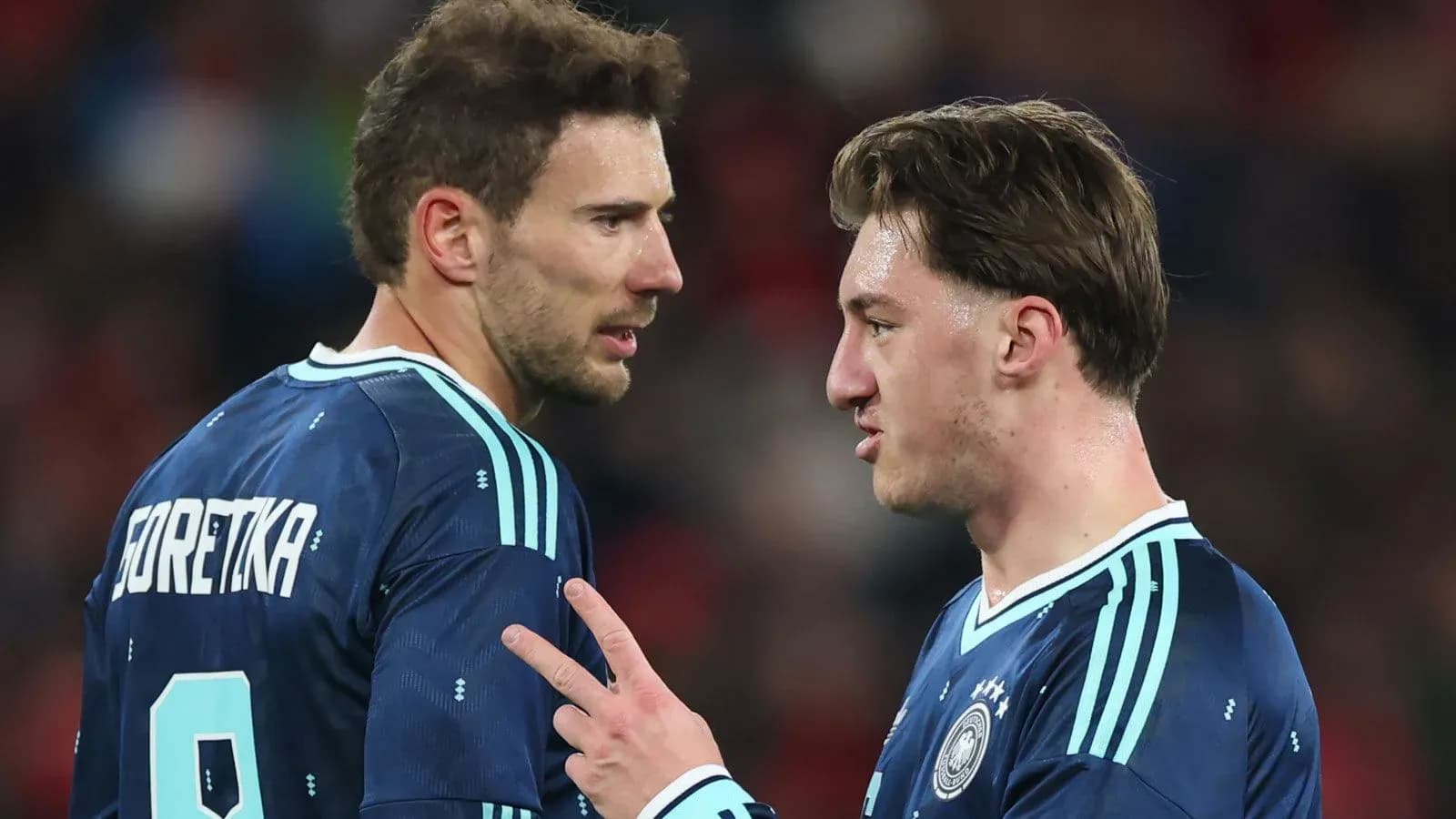
Enter Leon Goretzka. He did not dazzle, but he fits the profile Nagelsmann wants next to Pavlovic or Nmecha. The coach had already outlined his role: a line-breaker on the top line, a free radical whose runs pin opponents and open passing lanes. In the closing stages against Ghana, Goretzka executed that idea neatly with the pass before Sané’s assist for Undav.
With Kimmich shuttling between right-back and central midfield, Goretzka’s absence in deeper zones goes largely unnoticed in games where Germany dominate the ball. The captain, for his part, was heavily involved, using his passing range and composure much as he does at Bayern. Defensively, he did a respectable job, though he left space behind him and was partly culpable for one of the goals conceded against Switzerland.
The bigger issue is structural: Nagelsmann has no convincing alternative at right-back. Josha Vagnoman’s return after three years away underlined that brutally. His weak defending before Ghana’s equaliser did little to strengthen his case. It would be no surprise if Benjamin Henrichs or Ridle Baku re-enter the conversation.
Schlotterbeck, Tah and the hierarchy at the back
At centre-back, the situation is clearer. Nico Schlotterbeck and Jonathan Tah will go into the World Cup as the undisputed first-choice pairing. Not even Schlotterbeck’s two costly errors against Switzerland will shake that.
Nagelsmann had already promised the BVB defender a starting place in an interview with kicker and doubled down after the game, backing him publicly. The reasoning is straightforward: Schlotterbeck is the only left-footed centre-back in the squad. In a ball-oriented system that relies on clean build-up and diagonal passing lanes, that detail is crucial.
His individual qualities are not in doubt. He defends aggressively in space, relishes one-on-ones and takes responsibility on the ball. Tah benefits from that, even if he can look slow to react in rapid transitions. Against Switzerland, he was too passive on two of the goals conceded, but he still sits comfortably ahead of Antonio Rüdiger in the internal ranking.
Rüdiger, now at Bayern, had a shaky moment against Ghana and was bailed out by Schlotterbeck, who prevented an earlier equaliser. He remains the first replacement, as long as he avoids further controversies at Real Madrid that could damage his standing.
Waldemar Anton, despite not playing a minute, can also feel safe. Like Groß, the Dortmund defender is valued for his professionalism and reliability. Nagelsmann even hinted strongly that he is “very likely” to be in the World Cup squad, praising his intensity in training and his willingness to accept a role as the man to see out tight leads. It is also a nod to a strong season at BVB.
Malick Thiaw, grouped with Anton, Schade and goalkeeper Finn Dahmen as the four unused players, remains a doubtful candidate. His position is anything but secure.
Nagelsmann’s tightrope
Hovering over all of this is Nagelsmann himself. His tactical ideas are clear, his squad shaping increasingly coherent – but his communication keeps dragging him into unnecessary skirmishes.
The Undav affair is the latest example. Publicly defined roles, a player who delivers and then asks for more, a coach who reacts sharply instead of defusing the situation. The contradictions are piling up: statements in kicker, the U-turn on Sané, the hard line on “role acceptance” that he then blurs in practice.
On the other hand, several of his calls have been spot on. The decision to bring in Alfred Schreuder and give set-piece coach Mads Buttgereit more freedom has already paid off. Two rehearsed routines led to goals against Switzerland – Tah and Wirtz both finishing from the training-ground script.
The football, at times, looks modern, aggressive, dangerous. The squad, while not free of gaps, is taking shape.
What remains unclear is whether Nagelsmann’s words will keep fuelling fires around the team or whether results will smother the sparks. The Undav question alone threatens to follow Germany all the way to the World Cup. If the coach gets this tournament right, nobody will care how bluntly he spoke in March.
If he does not, every sentence from this camp will be dragged back into the spotlight.