
Germany's Transformation: From Villains to Heroes in Brazil 2014
For decades, Germany were the team everyone respected and almost no one loved.
They blocked two of football’s most romantic stories: Ferenc Puskas’ Hungary in 1954, Johan Cruyff’s Netherlands in 1974. Both were hailed as the greatest European sides of their eras. Both were stopped by a relentless, pragmatic German machine in World Cup finals that many neutrals felt should have gone the other way.
By the 1980s, the image had curdled completely. The “Disgrace of Gijon” at the 1982 World Cup, when Germany and Austria sleepwalked through a result that knocked out Algeria, stained their reputation. Harald “Toni” Schumacher’s brutal collision with Patrick Battiston in the semi-final against France turned distaste into anger.
Sympathy never came. Trophies did. Euro 1980, the 1990 World Cup, Euro ’96 – Germany kept lifting silverware while the rest of the world muttered about cynicism and inevitability. Gary Lineker’s famous line captured the mood: “Football is a simple game. 22 men chase a ball for 90 minutes, and in the end, the Germans always win.”
Then something shifted.
The 2006 World Cup on home soil changed how Germany saw themselves – and how the world saw them. The “Sommermärchen”, that summer fairy tale, ended in a semi-final defeat to Italy, but the country staged a festival that felt open, joyful, even carefree. Four years later, in South Africa, a young, fearless Germany thrilled neutrals again, sweeping teams aside with pace and invention before falling narrowly to eventual champions Spain. The hard-edged winners were becoming crowd-pleasers.
By 2014, they arrived in Brazil with a new ambition: win the World Cup, and win hearts.
Red and black, Rio and a charm offensive
The first move came months before a ball was kicked. In February 2014, the DFB unveiled a new away shirt: red and black hoops, a clear nod to Flamengo’s iconic kit. For a nation whose away colours had traditionally been green, with the odd red or black, this was a statement.
“Your jersey for Rio,” read the campaign line.
Mesut Özil played along. “The new jersey looks great and reminds me of the Flamengo Rio de Janeiro kit,” he said. “It’s sure to bring us luck for the World Cup in Brazil.”
It was more than marketing. It was a calculated attempt to tap into the veins of Brazilian football culture.
The reaction was instant. Long before the opening game, the shirt was a phenomenon.
“When the German jersey in the colours of Flamengo was unveiled, I decided to cheer for Germany,” a Brazilian fan told local newspaper O Dia. He wasn’t alone. The shirt flew off the racks in Rio de Janeiro. Sports shops ran dry, and counterfeit versions flooded the Copacabana. In Munich, Bastian Schweinsteiger posed at Bayern’s training ground in an original Flamengo jersey, feeding the growing bond.
The wave carried into pop culture. A German expat in Rio, Bernhard Weber – better known as MC Gringo – saw his chance. Inspired by the new shirt, he wrote “Deutscher Fussball ist geil, beweg’ dein Hinterteil” (“German football is awesome, move your bum”). In the video, he danced through Rio’s streets, beaches, markets and favelas, switching between Portuguese and German, wearing the red and black Germany shirt, a Flamengo cap and flanked by a scantily clad Brazilian woman. The track soon echoed from beach bars and TV channels across the country.
By early June, when Joachim Löw’s squad finally landed in Brazil and moved into their purpose-built base at Campo Bahia, the groundwork was laid. The players leaned into it. Schweinsteiger and Manuel Neuer danced with locals to a Bahia club anthem. The whole team showed up at community events, visibly trying to connect.
“You can tell that the DFB team has taken an interest in Brazil and is making a lot of effort,” Brazilian sports journalist Renato Costa told Deutsche Welle. It was exactly the verdict Germany wanted.
Goals, scares and a nation warming up
On the pitch, they backed up the charm with football worthy of the stage.
A 4-0 demolition of Portugal in the opening game, fuelled by a Thomas Müller hat-trick, sent a clear message. A wild draw against Ghana followed, a reminder that this World Cup would not be a procession. Then came the first outing for the red and black away kit: a controlled win over the United States to top the group.
The knockout rounds brought drama and doubt. Algeria pushed Germany to the brink in the last 16, forcing extra-time before the favourites finally squeezed through. For all their attacking flair, Löw’s side looked vulnerable.
Brazil were living on the edge too. The hosts scraped past Chile on penalties in the last 16, a nerve-shredding shootout that left the country both drained and euphoric. In the middle of it all, Schweinsteiger and Lukas Podolski were filmed celebrating with Brazilian flags, their joy blending into the home nation’s. The clips went viral, another layer to an unlikely alliance.
Brazil beat Colombia in the quarter-finals but lost Neymar to a back injury. The country’s talisman was out; the mood turned anxious. Germany, meanwhile, headed for Rio and the Maracanã for the first time in the tournament, to face France.
For that city, and for Flamengo, this was more than a visit.
Flamengo: the red and black nation
Clube de Regatas do Flamengo began as a rowing club, then found its true calling with a ball at its feet. In the 1930s, Leonidas – Brazil’s first genuine football superstar and top scorer at the 1938 World Cup – lit up the club. In 1981, Zico led Flamengo to their first Copa Libertadores and then the Club World Cup, dismantling Liverpool in Tokyo. From there, Flamengo’s status as the people’s club hardened into something close to religion.
The roll call is staggering: Mario Zagallo, Bebeto, Romario, Ronaldinho, Adriano, Vinicius Jr. Almost every era-defining Brazilian talent has worn the red and black at some point. Recent years brought fresh glory: Brazilian league titles in 2019 and 2020, Copa Libertadores crowns in 2019 and 2022, Copa do Brasil triumphs in 2022 and 2024.
Surveys estimate Flamengo’s fanbase at around 47 million – over a fifth of Brazil’s population. They call themselves “the red and black nation”.
So when Schweinsteiger and Podolski posted a photo in Flamengo jerseys on a balcony overlooking Rio’s beach before that quarter-final against France, it hit home. This wasn’t a token gesture; it was a full embrace.
Podolski in particular dived headfirst into the relationship. During the tournament he tweeted regularly in Portuguese, posted photos with Ronaldo and Ronaldinho, and kept interacting with Flamengo fans long after the World Cup ended. Flamengo tried to sign him several times over the next decade.
“Everyone knows that I have loved Brazil since the World Cup, and especially the Flamengo club,” he told Globo Esporte. It sounded less like PR and more like confession.
On the Maracanã pitch, he and his team-mates did their talking with a 1-0 win over France, Mats Hummels rising to head in the decisive goal. Germany were into the semi-finals. Brazil awaited.
By then, the red and black Germany shirt had become a phenomenon of its own. Local media reported that more than half a million Germany jerseys had been sold in Brazil by the time the semi-final came around, most of them in Flamengo’s colours. Sports daily Lance asked readers to send in photos wearing the shirt. Back in Europe, adidas announced that sales were “exceeding all expectations”.
The stage was set for Belo Horizonte – and a game that would rewrite history.
7-1 and the night the world blinked
What happened next still feels surreal.
Müller. Miroslav Klose. Toni Kroos. Kroos again. Sami Khedira.
After 29 minutes, the scoreboard read Brazil 0-5 Germany. A semi-final. In Brazil. A demolition of almost cruel clarity.
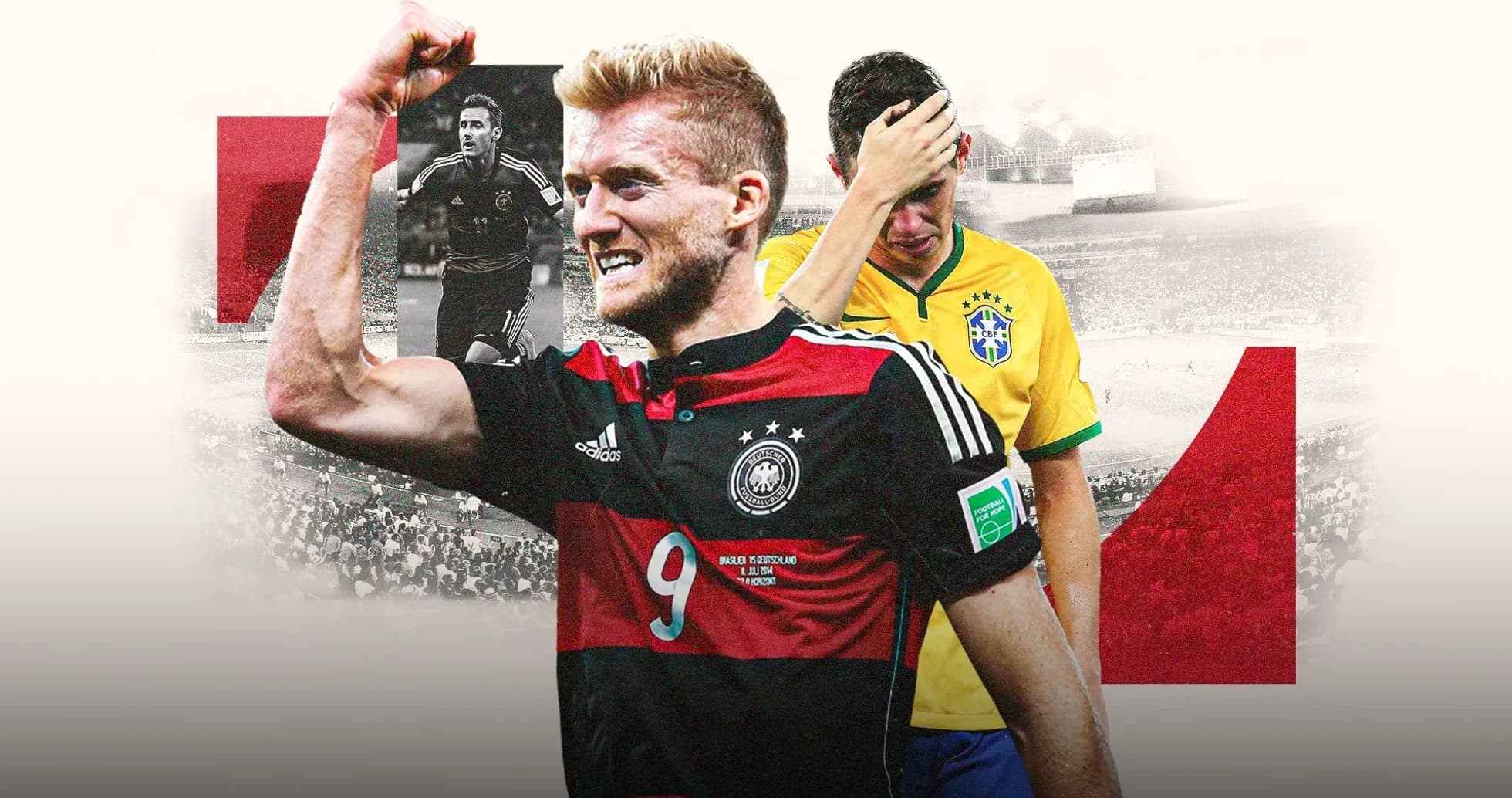
Löw urged restraint at half-time. His players listened, at least in part. They took the edge off, but the goals didn’t stop entirely. Substitute André Schürrle added two more in the second half. Oscar’s late consolation merely set the numbers in stone: 1-7. A national trauma for Brazil, a cold, brutal statement from Germany.
The reaction from the victors was telling. On social media, the DFB addressed Brazil in Portuguese: “Since 2006, we know how painful it is to lose a semi-final in your own country. We wish you all the best for the future.” The message came with images that cut through the noise – Schweinsteiger consoling David Luiz, Müller patting Dante on the back, Philipp Lahm comforting Oscar.
And one photograph that went around the world: an elderly Brazilian man with a moustache, tears streaming down his face as he clutched a replica World Cup trophy in the stands of the Estadio Mineirão. Later, in an act of grace amid heartbreak, he handed the trophy to a young German fan.
His name was Clovis Acosta Fernandes. A devoted supporter who had followed Brazil for years, he had just endured the most painful night of his football life. After the game, he posted an old photo on Facebook with Germany’s then team manager Franz Beckenbauer at the 1990 World Cup, adding a message in German: “I hope that on Sunday you will lift the trophy in the sacred temple of football, the Maracana.”
In that sentence, he captured the mood across much of Brazil. The humiliation hurt, but Argentina hurt more. The hosts turned, almost instinctively, towards their conquerors.
“We are all Germany”
By the time the final rolled around, Brazil had picked a side.
Portal UOL claimed Germany were “more Brazilian than Brazil” – for their style of play and, yes, for that red and black shirt. O Estado de São Paulo praised the team’s “exceptional behaviour”, saying they had “learned to understand the spirit of this region”. Lance, looking ahead to the showdown with Argentina, ran a simple line: “We are all Germany”.
In the Maracanã, the support reflected those headlines. German fans had travelled in numbers, but they were joined by thousands of Brazilians who roared for Löw’s side and against Lionel Messi’s Argentina.
The final itself was tense, tight, almost suffocating. Chances came and went. Nerves frayed. Then, deep into extra-time, Mario Götze chested down a cross and volleyed home from close range. One clean strike, and Germany had their fourth World Cup.
They left Brazil not just as champions, but as something rarer: a German team embraced beyond their borders.
Podolski made sure the symbolism landed. In the celebrations, he posed with the World Cup trophy wearing a Flamengo jersey. For the red and black nation, a little piece of that night in Rio belonged to them too.
Germany had once been the cold, efficient villains of world football. In Brazil in 2014, dressed in red and black and dancing to local rhythms, they became unlikely heroes. The trophies stayed the same. The story around them did not.



