Gabriel Saga Highlights United's Challenge to Retain Young Talent
Real Madrid want him. So do Barcelona, Paris Saint-Germain and Bayern Munich. Manchester United, though, are digging their heels in over Gabriel.
The club have no intention of signing off on the teenager’s exit, and senior figures are now scrambling behind the scenes to change his mind. If they fail, the fallout will land squarely at the feet of INEOS chairman Sir Jim Ratcliffe, already a target for protests after a string of unpopular calls since taking charge of football operations. Letting a once-in-a-generation academy talent walk away would haunt him.
Gabriel is under contract until next summer, but the situation is messy. He is not a full-time scholar and not part of the club’s full-time model, which means that on October 16, when he turns 16, he could technically leave for a club in the European Union – provided he holds a European passport.
United are now poring over that detail. His father, Joe O’Cearuill, is a former professional who represented Ireland twice, while his mother is of Greek Cypriot heritage. Under post-Brexit rules, that dual-national route could allow Gabriel to move abroad before 18 if he qualifies for an EU passport.
United already won one battle for him, prising him away from Manchester City’s grasp last year. This one feels different. It feels like his head has turned.
The signs are there. Gabriel was scheduled to train with the first team on Saturday. He didn’t show. He has not been seen at Carrington all week.
Carrick’s plan ripped up
Michael Carrick had been ready to take the next step with him. Gabriel was set to be in the squad for Wednesday night’s Carabao Cup third-round tie against Brighton at Old Trafford. One appearance, even a late cameo, would have made him the youngest player ever to feature for United’s senior side.
That dream has been shelved. His involvement has been ruled out.
For a club still living off the glow of Marcus Rashford’s breakthrough, this stings. United’s academy has not produced a genuine global superstar since Rashford burst onto the scene. Gabriel, ever since he arrived as an 11-year-old, has carried the weight of that hope.
He plays like someone who has always been a step ahead of his age group: a two-footed forward with sharp, darting feet, the balance to slip out of tight spaces and the composure to finish when the chance appears.
The Lionel Messi comparisons do him no favours, but stylistically he leans closer to Neymar – one of the Barcelona great’s former team-mates. Gabriel even wears the same Nike boot model as the Brazilian, having signed a lucrative extension with the sportswear giant in March 2025.
His numbers back up the hype. At 14, he broke into United’s Under-18s – another record – and promptly scored 20 goals in 21 league matches. That haul brought him the first-ever Premier League U18s Player of the Year award and United’s Jimmy Murphy Young Player of the Year prize, the youngest recipient in the club’s history.
By August he had stepped up to the U21s. On debut against Ipswich he delivered two assists and a delicate chip in a 5-0 win. A week later, he scored again as United thrashed Leicester City 4-1.
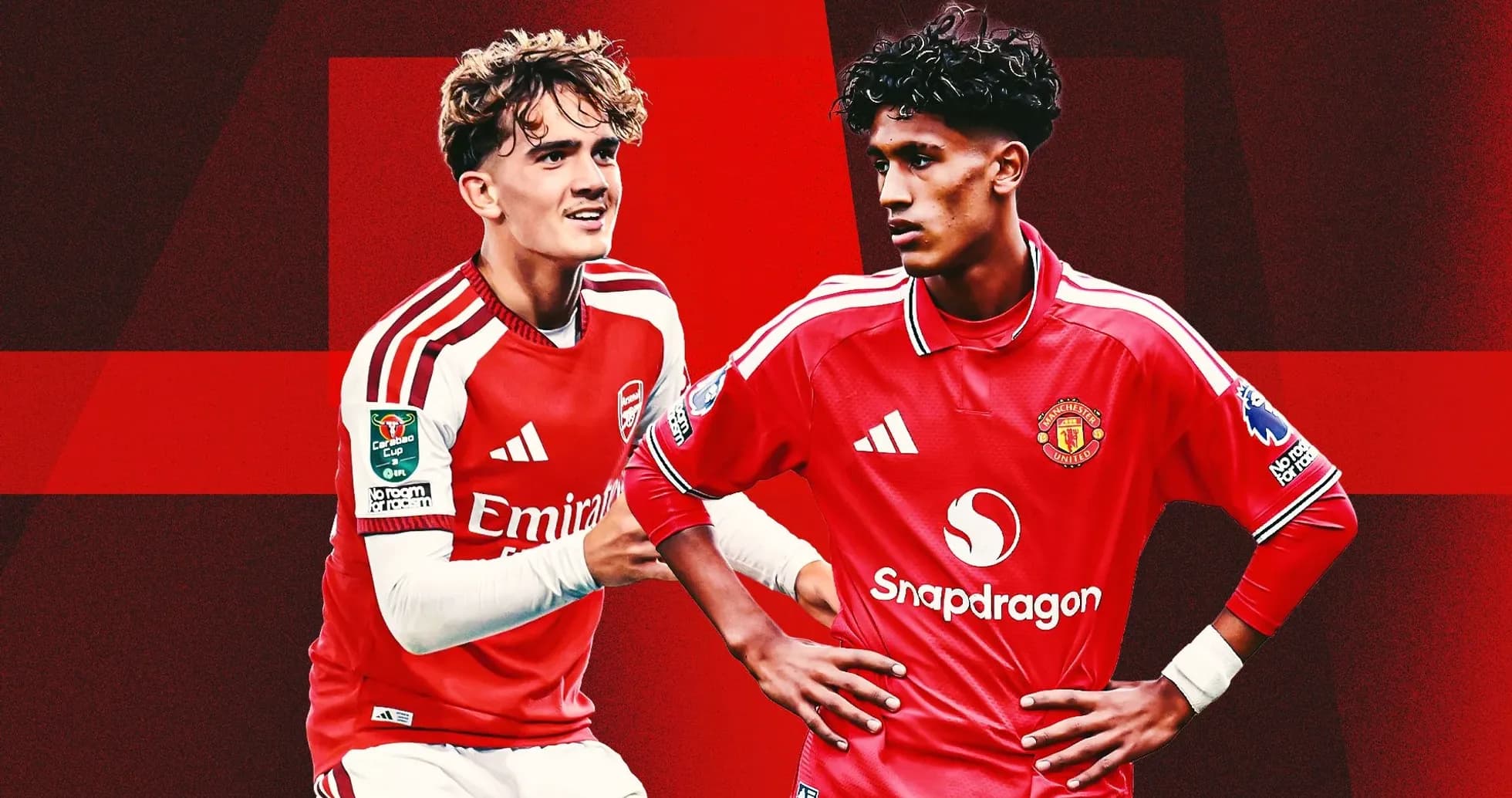
It all paints the picture of a teenager operating several rungs above his age group. No wonder the clamour for Carrick to throw him in has grown louder, especially with United starved of inspiration in the final third and with Max Dowman lighting up Arsenal.
Dowman, Nwaneri and the lure of fast-tracking
This is not a vacuum. Young players talk, they watch, they compare.
Ethan Nwaneri set the modern benchmark when he came on for Arsenal at Brentford in September 2022, becoming the youngest player in Premier League history at 15 years and 181 days. His path has not been linear – loans to Marseille and Borussia Dortmund followed – but he already has over 50 senior appearances for Arsenal and, at 19, still owns a promising future.
Arsenal doubled down on that youth-first bravery with Max Dowman. Mikel Arteta sent him on against Leeds in August 2025, making him the league’s second-youngest player. Dowman then tore up the record books, breaking James Vaughan’s mark as the Premier League’s youngest scorer with a brilliant solo goal against Everton at 16 years and 139 days.
He didn’t stop there. In May he became the youngest title-winner in Premier League history. This week he echoed Wayne Rooney by becoming only the second 16-year-old to score a brace for a Premier League club in a major competition, as Arsenal beat Ipswich 4-2 in the Carabao Cup.
Fourteen senior appearances already, and each one shows the same blend: flair, fearlessness and a frame that can handle the league’s physicality. Arteta has even mentioned Dowman in the same breath as Messi, yet has been careful not to overcook him, choosing his moments to unleash the teenager.
"We have to look after him. He's 16 years old. You don't see that in this league," Arteta said after the Ipswich tie. He stressed the unique demands of the Premier League and the need to ensure Dowman is used only with the right preparation and in the right context.
Gabriel is not built like Dowman. Not yet. He is slight, often the smallest player on the pitch. His courage and determination close part of that gap, but not all of it. Throwing him into the Premier League furnace too soon could backfire for United – especially if he explodes straight away.
If he starts brilliantly, Carrick would face pressure to pick him every week. That is a dangerous load for a teenager’s body. Arteta can rotate Dowman, shield him, because Arsenal have depth and a defined structure that keeps winning regardless of the XI.
United do not have that luxury. The squad is thinner, the performances wildly inconsistent. If Carrick were to pull Gabriel out of the firing line after an initial burst, he would be accused of being too cautious. If Gabriel struggled to impose himself, he would be branded overrated.
So Carrick has been cautious, and in the eyes of former United academy graduate Danny Simpson, wise.
Speaking to GOAL courtesy of Free Bets, Simpson drew the contrast. He pointed to Dowman’s environment: a side flying, full of elite players, where even the “second XI” can steamroll opponents. That was his experience under Sir Alex Ferguson. As a youngster, he could come on for 10 minutes with United already 2-0 or 3-0 up, surrounded by serial winners.
That is not the current United.
"I know we all want to see Gabriel play and it's exciting, but it's just a very different situation to Max Dowman at Arsenal," Simpson said. He believes Carrick will know when to act, just as United have carefully eased in Shea Lacey. For now, Simpson’s view is clear: let Gabriel train, keep him around the group, and trust that his time will come.
Yamal, La Liga and the European temptation
Patience, though, is a hard sell when your peers are already living the dream.
Even if Gabriel accepts that his case differs from Dowman’s, he only has to glance at Lamine Yamal’s rise at Barcelona to feel the itch. Yamal was also skinny when he debuted in 2023 at 15 years, nine months and 16 days. His slight frame made him a target, but his explosive acceleration and sharp football brain allowed him to evade trouble.
La Liga helps. The game there leans more on tactical control and possession than the Premier League’s relentless, high-intensity transitions. It is a more forgiving environment for technicians. In England, with less time on the ball and more emphasis on duels, Yamal’s path might have been far steeper.
Gabriel may look at Barca or Real Madrid and see a fast-track to stardom. It is an understandable thought. It is also a risky one.
Timing is everything. When Yamal broke through, Barcelona were marching toward the La Liga title under Xavi but had crashed out of the Champions League at the group stage. Raphinha, Ousmane Dembele and Ferran Torres were not the forces they are now. There was space for Yamal to disrupt the hierarchy.
Today, the picture is different. Barca can call on Yamal, a peak Raphinha, Anthony Gordon, Karim Adeyemi and Gabriel Jesus in attack. Across the Clasico divide, Jose Mourinho has Kylian Mbappe, Vinicius Junior, Jude Bellingham and Yan Diomande at Real Madrid.
Where does a 16-year-old fit in that pecking order? He waits. Just as he would at PSG. Just as he likely would at Bayern.
At United, the path is clearer. Imperfect, but clearer. The team’s flaws open up opportunities that simply do not exist at clubs stacked with world-class forwards. If Gabriel insists on “everything now”, he risks blocking his own route.
United’s line in the sand
United, for their part, cannot afford to be held hostage by a boy still 18 months from sitting his GCSEs, no matter how gifted. The club believe Carrick and the academy staff have handled him correctly so far and will continue to do so – if he stays and resets.
If he does not, there is little value in a protracted stand-off. The longer the saga drags on, the more it distracts from United’s attempts to claw their way back from a poor start to the season. Whether pushed by advisers or family, Gabriel is acting from a position of perceived privilege.
United’s history tells a different story. George Best, Sir Bobby Charlton, Ryan Giggs, David Beckham, Paul Scholes, Gary Neville – none of them were handed anything. They earned it, day after day, under the most demanding standards on and off the pitch.
Former manager Ruben Amorim, heavily criticised and eventually sacked in January, still nailed one uncomfortable truth before he left. "There is a feeling of entitlement we have in our club," he said, arguing that difficult moments can be good for young players and that constant praise does them no favours. He urged them to stay, to fight, to overcome.
He got plenty wrong. On that point, he was right.
With his current mindset, Gabriel will not transform United’s fortunes. The most important lesson any academy player must absorb is simple: no individual is bigger than the club.
If that lesson does not land, United may be better off stepping aside and watching him chase his personal brand somewhere else – while they search, once again, for the next Gabriel.