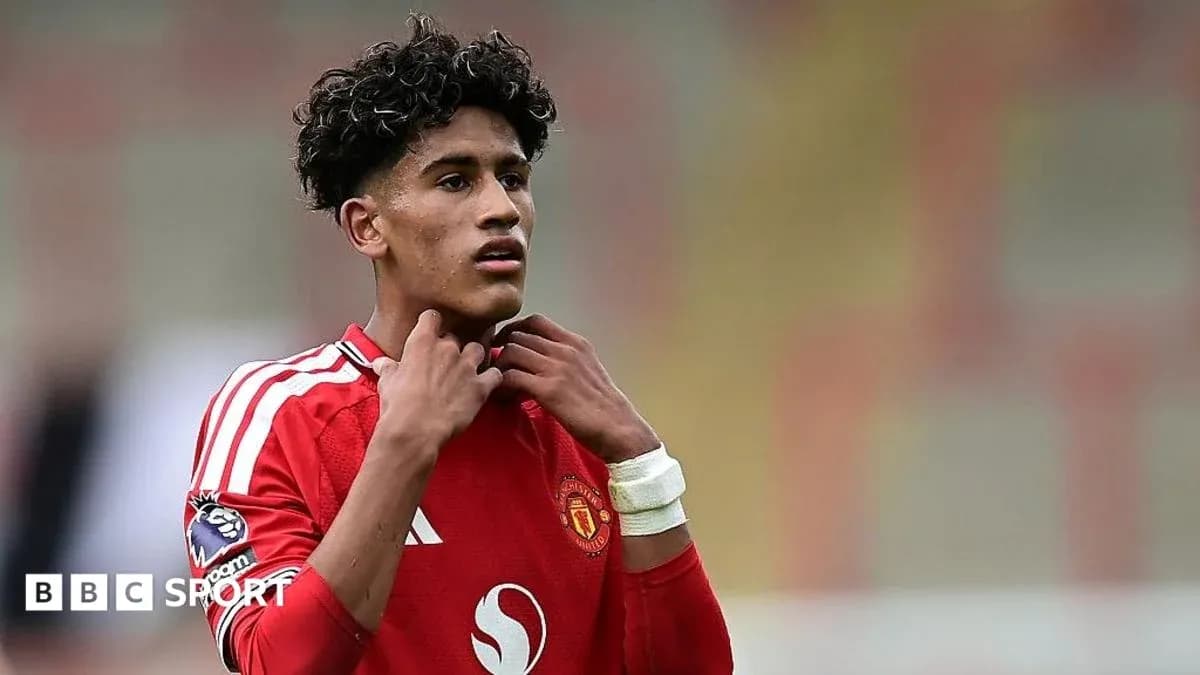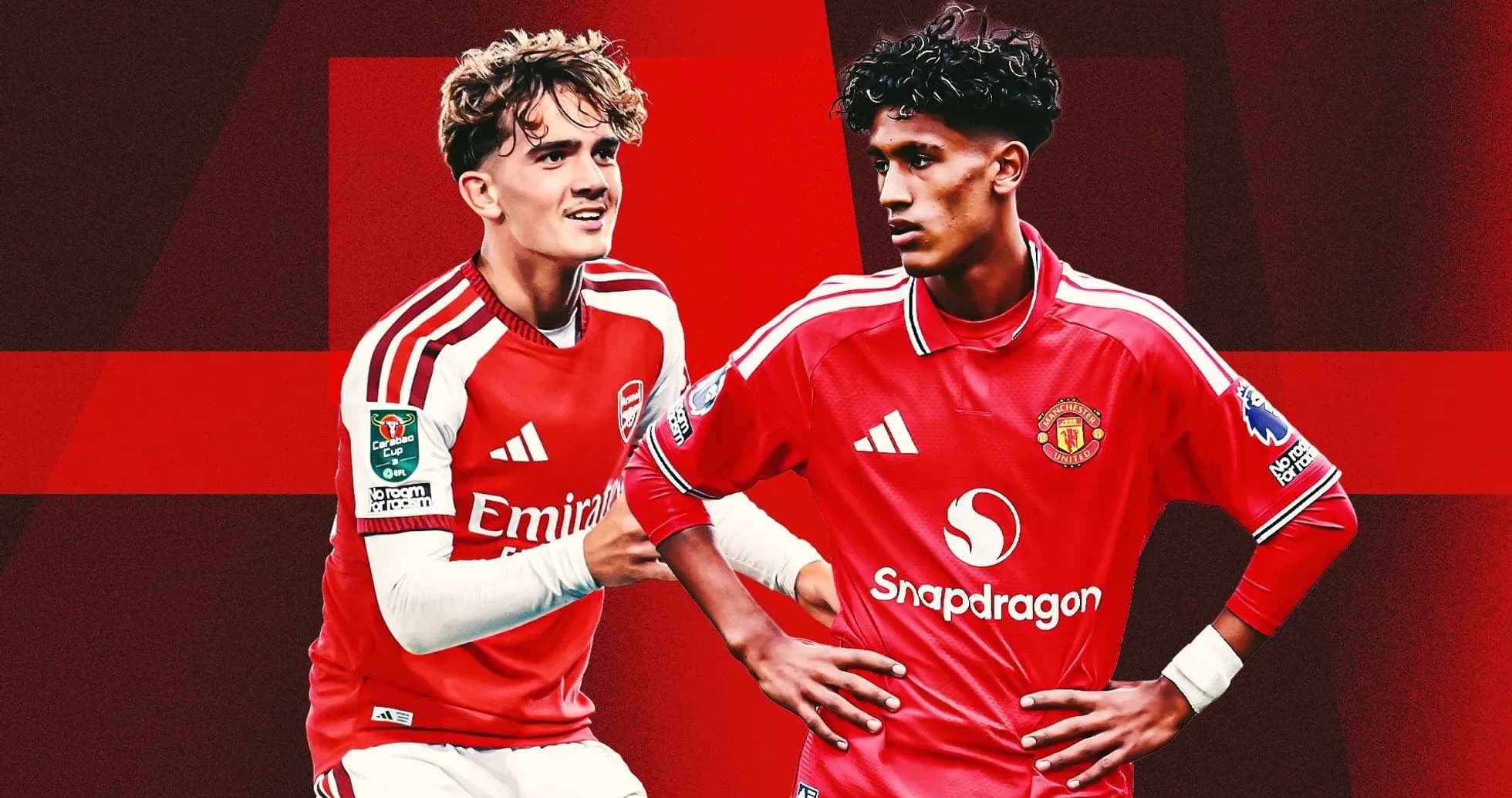
Gabriel: Manchester United's Teenage Prodigy at a Crossroads
Gabriel, Manchester United’s teenage prodigy, has become the centre of a tug of war that stretches from Old Trafford to the European elite. Real Madrid, Barcelona, Paris Saint-Germain and Bayern Munich all want him. United, though, are digging their heels in.
They have to.
Sir Jim Ratcliffe has already felt the anger of the fanbase since stepping in as the public face of United’s football operation. Letting a 15-year-old widely viewed inside the club as a once-in-a-generation talent walk away for nothing would turn dissent into open revolt. Gabriel is tied to United until next summer, but he isn’t a full-time scholar and, crucially, Brexit has changed the rules of the game.
Because of his background, the door is open.
His father, Joe O’Cearuill, is a former professional who represented Ireland. His mother is of Greek Cypriot heritage. If Gabriel holds a European passport – something United are urgently exploring – he could leave England when he turns 16 on October 16 and join any club inside the EU. For free.
United fended off Manchester City to land him last year. This fight feels far more dangerous. The signs are ominous: Gabriel was due to join first-team training on Saturday. He didn’t turn up. He hasn’t been seen at Carrington all week.
Carrick’s Plan
Carrick’s plan was clear. The United manager intended to include him in the squad for Wednesday’s Carabao Cup third-round tie against Brighton at Old Trafford. Had he stepped onto the pitch, Gabriel would have become the youngest player in United’s history. That dream has been shelved. His involvement is now off the table.
A Beacon in a Dim Era
United’s academy has not produced a genuine global superstar since Marcus Rashford burst through. Gabriel has carried that weight of expectation since he arrived as an 11-year-old. Those inside the system talk about a two-footed forward with freakish agility, a player who can twist away from pressure in impossible spaces and finish coldly when the chance appears.
The Lionel Messi comparisons are lazy and unhelpful. His game, in truth, more closely resembles Neymar’s – that same low centre of gravity, that same swagger in tight areas. He even wears the same model of Nike boots as the Brazilian after signing a lucrative extension with the brand in March 2025.
The numbers back up the hype. Last season he broke into United’s Under-18s at just 14, another record, and plundered 20 goals in 21 league games. He took home the first ever Premier League U18s Player of the Year award and became the youngest winner of United’s Jimmy Murphy Young Player of the Year.
This season, the climb has continued. Promoted to the U21s in August, he marked his debut against Ipswich with two assists and a deft chip in a 5-0 win. A week later, he scored again as United hammered Leicester City 4-1.
This is not a normal 15-year-old. That’s why the clamour around him has grown so loud. United’s senior side lack spark in the final third. Arsenal have shown with Max Dowman what can happen when a club trusts a special teenager. Supporters look at that and ask: why not Gabriel?
The Dowman and Yamal Effect
The modern teenager does not live in a bubble. Gabriel can see what is happening elsewhere.
Ethan Nwaneri broke the Premier League age record in September 2022 when he came on for Arsenal at 15 years and 181 days. His path has not been straightforward – loans to Marseille and Borussia Dortmund, dips and surges in form – but he now has more than 50 senior appearances and, at 19, plenty of time to grow.
Then came Dowman. Arsenal doubled down on the old line: if you’re good enough, you’re old enough. Dowman became the Premier League’s second-youngest player when Mikel Arteta sent him on against Leeds in August 2025. In March, he produced a stunning solo goal against Everton to become the youngest scorer in league history at 16 years and 139 days.
He didn’t stop there. In May, he became the youngest title-winner the league has ever seen. This week, he matched Wayne Rooney as only the second 16-year-old to score a brace for a Premier League club in a major competition, firing Arsenal to a 4-2 Carabao Cup win over Ipswich.
Fourteen senior games already. A teenager with flair, strength and timing, making himself impossible to ignore. Arteta himself has mentioned Dowman alongside Messi, but he has also shown restraint, choosing his moments to unleash him.
“We have to look after him. He’s 16 years old. You don’t see that in this league,” Arteta said after the Ipswich game, stressing the physical and mental demands of English football and the need to pick the right context every time Dowman plays.
That quote will not have gone unnoticed in Manchester.
A Different Body, A Different Club
Gabriel is not Dowman physically. Not yet. He is slight, often the smallest player on the pitch. His bravery and determination bridge some of that gap, but not all of it. Throwing him into the Premier League cauldron could go badly wrong for United.
Imagine he explodes onto the scene. The pressure to start him every week would be relentless, his body asked to cope with a schedule even hardened professionals struggle with. Arteta can drop Dowman in and out because Arsenal’s squad is deep and balanced, winning games with or without him.
United do not enjoy that luxury. Their performances fluctuate wildly. If Carrick were to bench Gabriel after an early run of games, he would be accused of stifling talent while the team stutters. If Gabriel struggled, the same voices would call him overrated and overhyped.
So Carrick has been cautious, and some within the club believe, wise.
Danny Simpson, a United academy graduate who broke through under Sir Alex Ferguson, understands the dilemma. Speaking to GOAL courtesy of Free Bets, he drew a clear line between Dowman’s situation and Gabriel’s.
Simpson recalled coming into a United side that was usually cruising: “I could come on for 10 minutes because most of the time we were 2-0 up, 3-0 up… I’d be playing with the second XI who could win the Premier League!” Dowman, he argued, is stepping into a similar environment – a team “flying in confidence, full of top, top talent, winning games.”
United, he said bluntly, are not that right now. He urged patience: let Gabriel train, be around the squad, and trust that his moment will come.
Yet patience is a hard sell when a teenager sees his peers fast-tracked to stardom. Dowman at Arsenal. And, perhaps most tantalising of all, Lamine Yamal at Barcelona.
The Lure of Spain
Yamal was still 15 when he made his Barcelona debut in 2023 – 15 years, nine months and 16 days. Like Gabriel, he was skinny, light, easy to knock over in theory. On the pitch, his speed and intelligence made him untouchable.
La Liga’s rhythm helped. Spain’s top flight leans more towards control and structure than the breathless transitions of the Premier League. It gives technicians room to breathe. In England, where time on the ball is a luxury, Yamal might not have risen quite so fast.
So Gabriel looks at Barcelona or Real Madrid and sees a shortcut. A fast track to the spotlight. On the surface, it makes sense. Underneath, it is more complicated.
When Yamal broke through, Barcelona were marching towards the La Liga title under Xavi but had crashed out of the Champions League in the group stage. Raphinha, Ousmane Dembele and Ferran Torres were not yet operating at their current levels. There was space for a teenager to disrupt the hierarchy.
That landscape has changed. Barcelona now boast Yamal, a peak Raphinha, Anthony Gordon, Karim Adeyemi and Gabriel Jesus across the front line. In Madrid, Jose Mourinho can call on Kylian Mbappe, Vinicius Junior, Jude Bellingham and Yan Diomande. These are not forgiving dressing rooms for a 16-year-old trying to leapfrog the queue.
Wherever he goes, Gabriel will have to wait. The difference is that at United, the path to a regular role is clearer. If he insists on everything, now, he risks losing the very thing he wants.
United’s Line in the Sand
There is a hard truth at the heart of this saga. Manchester United cannot allow themselves to be held hostage by a 15-year-old, however gifted, who is still 18 months from sitting his GCSEs.
Carrick and the academy staff have nurtured Gabriel carefully so far. They will keep doing so if he stays and buys in. If he doesn’t, if his head is already in Madrid or Barcelona or Paris, then at some point the club has to step aside and let him go.
A drawn-out standoff would only distract from United’s attempts to recover from a poor start to the season. Whether pushed by advisers or acting on his own instincts, Gabriel is moving like a player who believes the world owes him a shortcut.
That mindset jars with the history of the club he currently represents. Homegrown icons such as George Best, Sir Bobby Charlton, Ryan Giggs, David Beckham, Paul Scholes and Gary Neville built their reputations on relentless work, not entitlement. Nothing arrived on a silver platter. Standards were non-negotiable, on and off the pitch.
Even Ruben Amorim, whose brief reign as United manager ended in failure in January, struck a nerve when he spoke about the culture creeping into the modern game. “There is a feeling of entitlement we have in our club,” he said. Difficult moments, he argued, are not always a bad thing for young players; constant praise and instant gratification do them no favours. “Let’s stay. Let’s fight. Let’s overcome.”
Amorim got plenty wrong. On this, he was right.
If Gabriel cannot accept that no one is bigger than Manchester United, if he cannot see that greatness usually comes to those who stay and fight rather than those who chase the next badge, then the club may soon face a brutal decision.
Keep bending to keep the boy. Or let him go and discover, somewhere else, that talent alone never guarantees the stage he craves.