Fiorentina vs Genoa: Tactical Stalemate in Goalless Draw
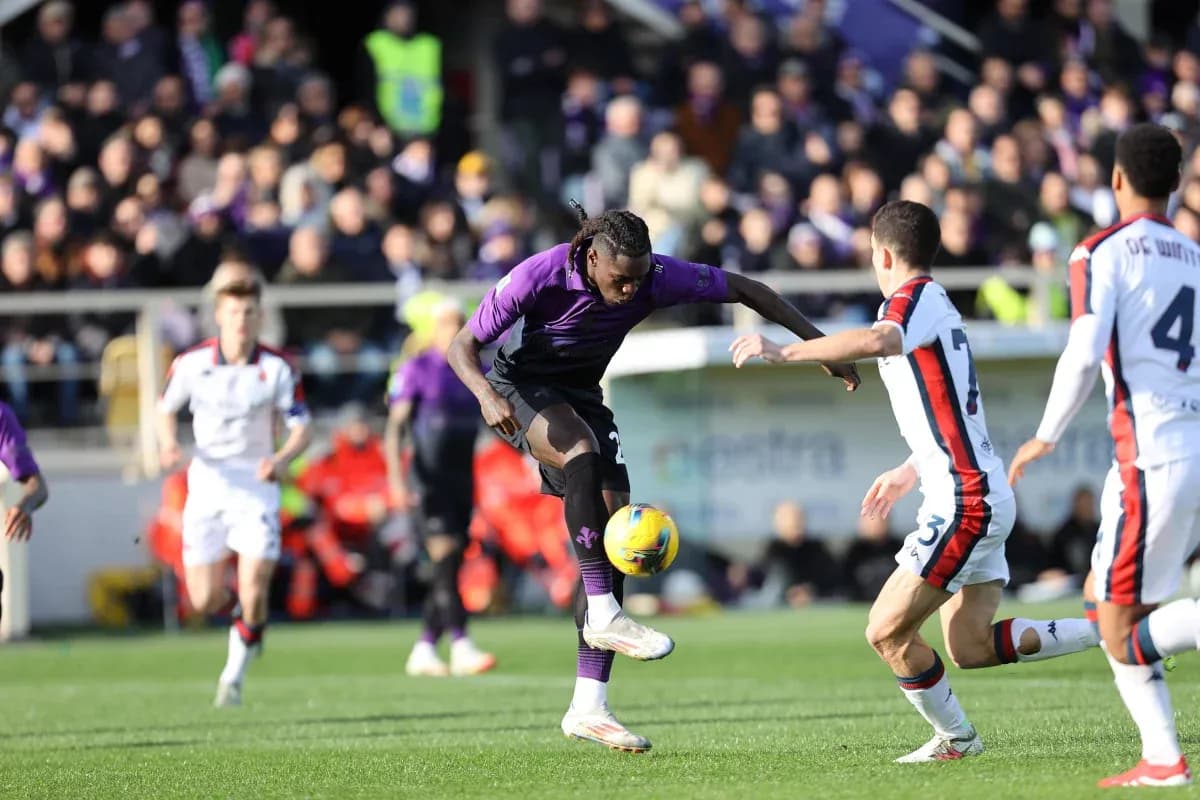
Fiorentina and Genoa produced a goalless but tactically nuanced draw at Stadio Artemio Franchi, a match defined more by structure and risk management than by penalty-box chaos. Across 90 minutes, Fiorentina’s 4-3-3 under Paolo Vanoli controlled territory and possession, while Daniele De Rossi’s Genoa in a 3-4-2-1 focused on compactness, vertical breaks, and efficiency. The statistical profile – Fiorentina 0.97 xG to Genoa’s 0.58, and 57% possession to 43% – underlined a home side that probed more, but struggled to convert volume into clear chances, against visitors who accepted less of the ball but created relatively dangerous moments when they advanced.
With no goals and no cards recorded, the key storyline becomes how each side used its structure. Fiorentina’s 4-3-3 was clearly designed to dominate the ball and pin Genoa back. The back four of Dodo, M. Pongracic, L. Ranieri, and R. Gosens provided a stable first platform, with Gosens and Dodo positioned high and wide to stretch Genoa’s wing-backs. In midfield, R. Mandragora, N. Fagioli, and C. Ndour offered a mix of circulation and half-space occupation, while the front three of F. Parisi, R. Braschi, and M. Solomon aimed to attack the channels outside Genoa’s back three.
The shot map numbers reinforce this: Fiorentina generated 13 total shots (9 inside the box, 4 from outside), but only 1 shot on target. That imbalance indicates that while they frequently reached the final third and into shooting positions, Genoa’s last-line pressure and blocking were effective – Genoa allowed 5 blocked shots, a high share of Fiorentina’s attempts. Genoa’s 3-4-2-1, with L. Ostigard anchoring alongside A. Marcandalli and N. Zatterstrom, held a relatively deep line, compressing space between defence and midfield. The wing-backs M. E. Ellertsson and A. Martin had a dual brief: narrow defensively to form a back five, then spring wide on transition.
In possession, Fiorentina’s 417 passes (353 accurate, 85%) show a controlled, short-passing approach. De Gea’s involvement as a distributor from the back, plus the full-backs’ high positioning, allowed Mandragora and Fagioli to receive between Genoa’s first and second lines. However, the lack of penetration into the central lane is suggested by the modest xG (0.97) relative to shot volume: many of the box entries likely ended in pressured, low-quality efforts rather than free finishes.
Genoa’s plan was more selective. They completed 316 passes (255 accurate, 81%), accepting longer spells without the ball but aiming to progress quickly when they did win it. Their 9 total shots (6 inside the box, 3 outside) and 3 shots on target – triple Fiorentina’s on-target count – point to a side that reached dangerous zones less often, but with a clearer final action when they did. Vitinha and L. Colombo offered depth and physical presence up front, while J. Ekhator operated in pockets to connect midfield to attack, particularly once substitutions reshaped the front line.
The goalkeepers’ numbers sharpen the tactical picture. D. de Gea made 3 saves, while J. Bijlow recorded none. For Genoa’s keeper, zero saves does not imply total dominance; rather, it reflects Fiorentina’s inability to test him despite their territorial control and shot volume. De Gea’s 3 saves, against an xG of 0.58 for Genoa and a goals-prevented value of 0, suggest he dealt competently with the efforts on target but was not asked to produce extraordinary interventions. Defensively, Fiorentina’s structure and rest-defence behind the ball limited Genoa to sub-1.0 xG despite the visitors’ efficiency when they reached the area.
The substitution pattern in the second half reveals both coaches’ attempts to tilt a finely balanced tactical battle. At 58', Genoa made the first move: L. Colombo (OUT) was replaced as C. Ekuban (IN) came on for him. This shifted the profile of the central forward role, adding more mobility and channel running to stretch Fiorentina’s centre-backs. Fiorentina responded on 61', adjusting the front line as R. Braschi (OUT) made way, with R. Piccoli (IN) coming on for him, likely to add a different reference point in the box and improve aerial presence against Genoa’s back three.
On 71', De Rossi doubled down on midfield and attacking refresh. J. Ekhator (OUT) was replaced as R. Malinovskyi (IN) came on for him, adding long-range threat and better final-ball quality between the lines. Simultaneously, A. Martin (OUT) left the pitch as W. L. Ouedraogo (IN) came on for him, a tweak at wing-back or wide centre-back zone to maintain energy on the flank. Vanoli countered in central midfield: at 72', R. Mandragora (OUT) was withdrawn as M. Brescianini (IN) came on for him, injecting fresh legs and potentially more vertical running from midfield. A minute later, 73', C. Ndour (OUT) was replaced as G. Fabbian (IN) came on for him, further rebalancing the midfield with a more box-arriving profile.
The final substitution wave at 82' and 86' reflected both sides’ late-game priorities. For Genoa at 82', A. Marcandalli (OUT) departed as M. Doucoure (IN) came on for him, and Amorim (OUT) was replaced as P. Masini (IN) came on for him. These changes likely preserved the structural integrity of the 3-4-2-1 while refreshing legs in the back line and central midfield to withstand Fiorentina’s late pressure. Fiorentina’s last move at 86' saw F. Parisi (OUT) leave the field as A. Gudmundsson (IN) came on for him, a clear attacking push to find a decisive action from the left side in the closing minutes.
Discipline had no direct impact: there were no yellow or red cards recorded for either side, despite 13 fouls by Fiorentina and 14 by Genoa. This allowed both coaches to keep their initial defensive anchors on the pitch and maintain structural consistency throughout.
Statistically, Fiorentina’s overall form in this match is that of a possession-dominant side lacking cutting edge: 57% of the ball, 13 shots, but just 1 on target and sub-1.0 xG. Genoa’s defensive index, by contrast, looks solid: they allowed volume but suppressed shot quality, protected Bijlow from serious work, and still generated 3 shots on target and 0.58 xG from only 9 attempts. With both goalkeepers at 0 goals prevented and the final score locked at Fiorentina 0-0 Genoa, the numbers support the eye test of a controlled, tactical stalemate in which neither side found the precision to turn structure into a decisive moment.