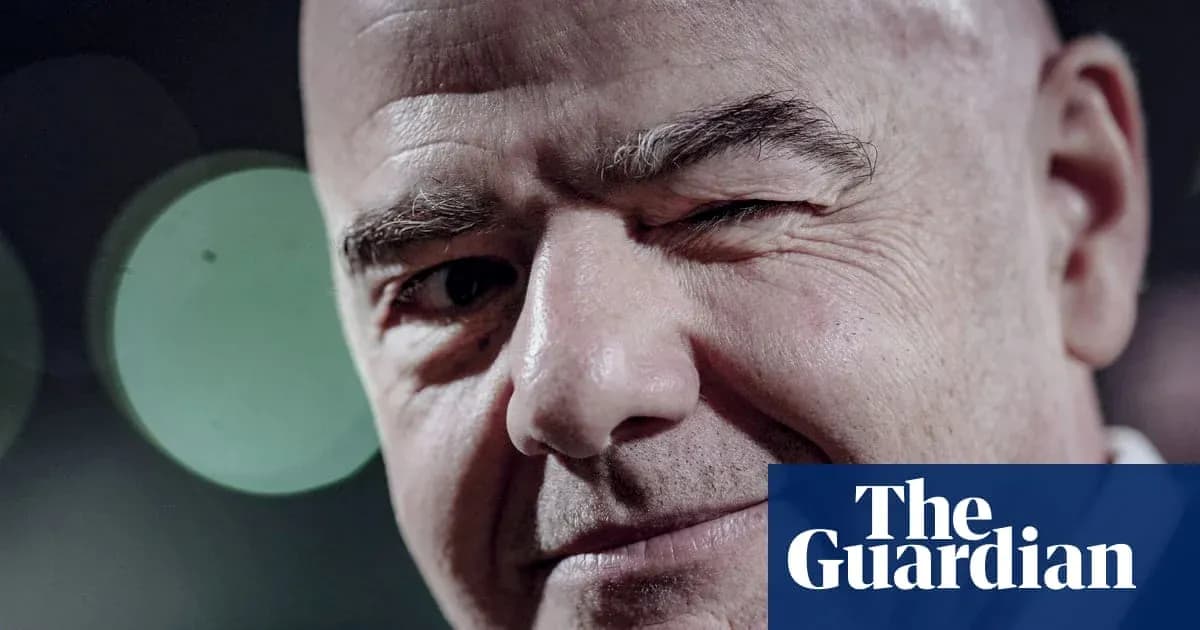
Fifa Power Play: Lamour's Exit and Infantino's Grip
Kevin Lamour knew what was coming. He said as much.
When Gianni Infantino’s scheme to flog off a slice of the World Cup to private investors was exposed last month, the then Fifa chief operating officer didn’t just raise an eyebrow. He torched the idea. Lamour dismissed the proposal as “the project of one person”, accused the administration of having been “deceived” by its own president and, in a line that now reads like a resignation letter in slow motion, added: “If speaking up means I lose my job, then so be it. I will understand and respect that decision. At least I’ll sleep well tonight.”
On Monday, the decision arrived. So be it.
“Fifa can confirm that the working relationship between Fifa and Kevin Lamour as Fifa’s Chief Operating Officer has ended on 17 August 2026,” came the carefully polished statement. “Fifa thanks Kevin for his two years of service and wishes him the best of luck for the future. No further comment will be made on the matter.”
The World Cup sell-off plan – a wheeze so flimsy it mainly succeeded in wrecking the holidays of reporters trailing Infantino through North American hotel lobbies – had already been quietly shelved. Lamour, the one senior figure prepared to say no, is the one now out of the door. Infantino remains, clinging to power like a barnacle welded to a hull.
Fifa’s refusal to elaborate surprised nobody. The vacuum was filled instantly.
Lise Klaveness, the Norwegian FA president and a long‑standing irritant to Infantino’s regime, went straight for the jugular. “Now he is thrown out and we are supposed to move on,” she said, furious at Lamour’s treatment. “It’s unacceptable, it’s management by fear.” She called Lamour “the best football administrator” she has ever met and then turned her fire on those still inside the tent: “Now we also have to call upon Fifa leadership and the administration to not submit to orders you know are not in the interests of football.”
Given recent history – the Geopolitics World Cup and everything that followed – she may as well be asking salmon to stop swimming upstream. But the message was clear, and it landed close to home.
Many read her words as a pointed swipe at Mattias Grafström, the Swedish Fifa official understood to have carried out the sacking at Infantino’s behest. Grafström responded in an email to staff that doubled as a mission statement for the bunker mentality in Zurich. “Individuals, unstable moments and unfortunate episodes come and go,” he wrote. “The institution, its mission and its responsibility towards world football continue.”
The implication was obvious: Lamour is an “episode”. Fifa is eternal.
For now, the clear signal from the top is that dissent will be punished, the machine will grind on and the sackings will keep coming until morale improves.
Guardiola, Passion and a Very Public Confession
Away from Fifa’s boardrooms, another power figure in football has been laying himself bare in a very different way.
In a new Amazon documentary, Pep Guardiola is shown addressing his players during a poor run of results and suddenly veering into his private life. “Guys I want to confess something, I’m [eff]ing divorced from the most beautiful woman on your planet,” he tells them. “It’s my wife, my ex-wife – I love her unbelievably, but we lost the passion. For many reasons, we lost the passion. I love her? Yes, absolutely. She loves me? Yes, but we lost the passion.”
Then he turns the knife back on his squad. “How do you play football, because you are paid? Or because of something inside? Where is the passion? In your life, whatever you are going to do, do it with passion. I don’t want any good players. I want players with passion.”
The cameras also catch another relationship under strain: Guardiola in a blazing row with Kyle Walker, a reminder that even at the very top, dressing-room dynamics can be as volatile as any title race.
Limbs in Cardiff: Colwill’s 98th-Minute Chaos
Scroll away from the politics and the documentaries and you find football doing what it does best: detonating pure, unfiltered joy.
At Cardiff City Stadium on Monday night, the word “limbs” finally earned its keep. Not the watered-down social media version that gets rolled out for any half-decent celebration. The real thing.
Cardiff, back in the Championship, were labouring. Wrexham, fuelled by Hollywood money and local needle, had taken an early lead through former Bluebird Kieffer Moore. More than 30,000 fans watched Cardiff huff and puff for over 90 minutes, frustration building in the Canton End as the clock bled into added time.
Then Rubin Colwill stepped up.
Deep into the 98th minute, he whipped a free-kick into the top corner, a shot so pure it seemed to drag the net and the noise up with it. The Canton End exploded. Bodies everywhere, strangers tumbling over seats, a blur of shirts and flailing arms. Proper limbs.
Even Brian Barry-Murphy, Cardiff’s head coach, vanished into the chaos, swallowed by the crowd as he celebrated. On their return to the second tier, the Bluebirds had rescued a point against their noisy neighbours and turned a grim night into an old-fashioned Championship thriller.
Transfers, Power Shifts and a Legend’s Next Step
While Cardiff were losing their heads, the market kept moving.
Rodri touched down in Barcelona on Monday to complete his move from Manchester City, calling it a “dream” to join the Catalan club. His medical is scheduled for Tuesday. “There have been some very intense days, but I’m happy that everything has been resolved,” he said, sounding more relieved than triumphant after a drawn-out saga.
In west London, Chelsea’s ownership puzzle is shifting again. Chair Todd Boehly and director Mark Walter are weighing up selling their shares to Clearlake Capital, the majority owners. If they cash out, Clearlake would take total control of the club. For supporters already uneasy about private equity’s grip on their team, it hardly feels reassuring.
Elsewhere, Coventry have moved decisively in the market, bringing in Taiwo Awoniyi from Nottingham Forest for £9m. Ipswich, still riding the momentum of their rise, have added Abdoul Ouattara and Julio Enciso from Strasbourg, Gary O’Neil’s former club. Newcastle, never shy when the right defender becomes available, have announced the £30m signing of Amar Dedic from Benfica.
On the touchline, one of the game’s great midfielders has a new stage. Patrick Vieira, born in Dakar and a World Cup winner with France, has been appointed as Senegal’s new manager. A national hero returns home with a clipboard and a mandate. The expectations will be fierce.
Memory Lane: Cigars, Champagne and a Different Age
And then there’s a photograph that says as much about football’s past as any balance sheet or documentary.
Leeds United, managed by Don Revie, celebrating their first title in 1969. Revie sits bottom left, surrounded by his players. Between nine of them, there are four bottles of champagne, two cigars and a single cigarette.
By the standards of the time, that counts as restraint. By the standards of today’s hyper-controlled, data-driven era, it feels like a transmission from another planet.
Lamour’s sacking, Guardiola’s confession, Colwill’s free-kick, Vieira’s new job, Leeds’ old cigars – different stories from different corners of the game. The same question lingers over all of them.
Who, in the end, still gets to decide what football should look like?