England's World Cup Campaign: Police Breath Tests and Match Highlights
In the half-light of a North-East rush hour, with commuters edging towards Durham city centre, the blue lights began to flicker.
Marked cars pulled out, officers stepped into the road and drivers were waved over at random. No chase, no drama – just a quiet, pointed operation aimed at a very modern World Cup problem: the morning after the night before.
Durham Constabulary had chosen their moment carefully. England had beaten Croatia 4-2 the night before, a statement start to their World Cup in Dallas, and the country had celebrated like it. Statistics show collisions rise by around 20% on England match days. With this tournament being played in North America, kick-off times land late into the UK evening. The fear is simple: fans drink deep into the night, sleep, wake up – and still get behind the wheel over the limit.
So on Thursday morning, the police waited.
Drivers were asked to step out and blow into roadside breathalysers. None failed while the Press Association watched, but one motorist discovered he was alarmingly close to the line. That was precisely the point.
Sergeant Sarah Manser did not bother dressing it up. “We come out this morning to give that message that alcohol still might be in your system the next morning,” she said. “We’ve had a couple this morning already who haven’t blown over the limit, but they have had alcohol in the system. Please just don’t and drink-and-drive, it’s just as simple as that.”
Some welcomed the intrusion. One of them, Louis Renwick, passed with no alcohol detected and had no complaints. “There’s too many deaths on the roads through drink-driving,” he said, standing by the roadside as the traffic crawled past.
The warning comes against the backdrop of a country throwing itself into a World Cup staged thousands of miles away, at times that test both body clock and common sense.
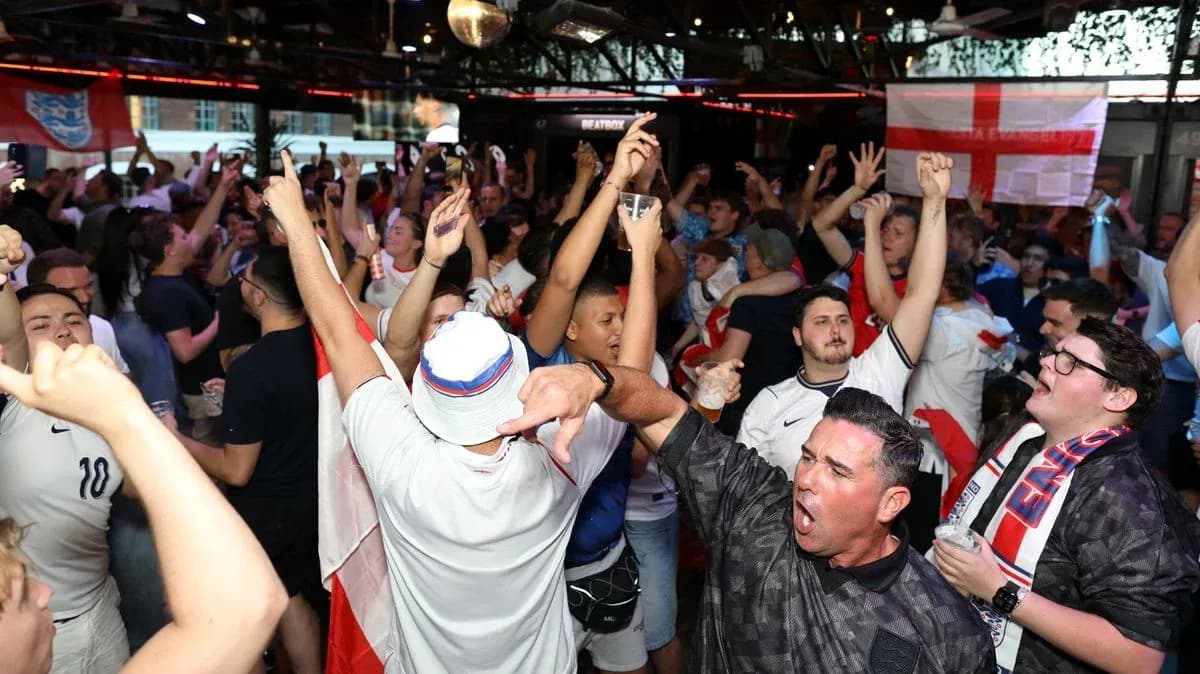
In Dallas, where England opened their Group L campaign, the party had been wild enough to shut down a pub.
The Londoner Pub – quickly dubbed the “Palace in Dallas” for the night – became the unofficial outpost of English football in Texas. Fans poured in, lured by a later closing time than most venues, and the tills rattled. By the end of the evening, the bar had shifted 2,352 bottles of beer and more than 5,000 beers in total, taking over £30,000 in a single night.
It was too much. With only two security guards on duty and supporters packed in shoulder to shoulder, police moved in at the start of the match. Videos showed officers ordering fans out even as they belted out the national anthem. The fire marshal later stepped in, and the pub was told to close early.
In a statement the following day, the Londoner made it clear the windfall came at a price. The “mayhem that descended on us”, they said, had brought damage to property and landscaping, and forced them to shut for the rest of the day on official orders. A reminder followed: this was not an isolated bar in the middle of nowhere but part of a complex with other businesses and nearby homes.
Inside the stadium itself, the tone was different but no less intense. England’s 4-2 victory over Croatia swung from chaos to control, from FA Cup-style scrap to World Cup theatre, and finally into what felt like a mass karaoke night.
They sang everything. “Hey Jude”. “Wonderwall”. “Sweet Caroline”. When Marcus Rashford lashed in England’s fourth in the 85th minute, sealing the win, “Football’s Coming Home” roared around the stands.
The atmosphere pulled in neutrals too. American fan Jessica Long, a former London Marathon runner, spoke with the wide-eyed excitement of a host-in-waiting. She revelled in the idea of the World Cup coming to her home city, calling it “an amazing day” and pointing to the sight of supporters from everywhere drawn into the same noise, the same spectacle.
On the pitch, the noise had its own protagonists.
Harry Kane, with a first-half brace, dragged himself level with Gary Lineker’s 10-goal World Cup record for England. Jude Bellingham and substitute Rashford finished the job in a ruthless second half that flipped the mood of the game and, perhaps, the mood around this England side.
Thomas Tuchel, orchestrating it all from the technical area, did not hide his admiration for his captain. He called Kane the “full package” and highlighted a moment that will never show on any Golden Boot chart: the centre-forward hurling himself in front of a shot in extra time to make a block.
“If you see the commitment of our captain, of our number nine, in the extra time to block a crucial shot after a set piece with all his body and his commitment to buy into a defensive action like this, then you know everything about his performance today,” Tuchel said. “Complete performance, absolute leader and he is all in – he's all in physically, he’s all in mentally, and he's all in.”
Kane’s own drive has another edge. With Kylian Mbappe and Erling Haaland both scoring braces in their opening games and Lionel Messi hitting a hat-trick for Argentina against Algeria, the race for the Golden Boot already feels loaded with star power.
“Obviously I saw the guys scoring their goals,” Kane said. “I don't like to concentrate on other people, but it is natural as a sportsman and athlete to want to reach the highest level. Those guys started in a great way.
“As a striker myself, I just want to get on the scoresheet as quickly as possible. In the back of my mind that competition helps me to push my levels. That is what the World Cup is for, to push myself at the highest level, so it is nice to get a couple.”
Tuchel, though, spread his praise. Bellingham, who struck two minutes after the restart to tilt the match, was described as a player who “loves these pressure games”, someone you can rely on when the temperature rises. Rashford, who came off the bench to stretch Croatia’s defence and score late, earned admiration for his sharpness in camp, his tactical understanding and the way he is pushing Anthony Gordon for a place without disrupting the squad’s balance.
Back in Europe, the bookmakers took note. Betway cut England’s odds to win the World Cup from 8/1 to 13/2. Their spokesperson Lewis Knowles called the second-half display a “real statement win” and said there now seemed to be “a real belief that football might actually come home this summer.”
Inside the camp, the belief comes with a tactical edge.
Kyle Walker, writing in The Sun, drew a clear line between Tuchel and his predecessor Gareth Southgate. The defender praised Tuchel’s willingness to change games from the bench, contrasting it with Southgate’s tendency to stick with his trusted XI.
Against Croatia, the difference felt stark. England went in at half-time at 2-2, twice pegged back, their control slipping. Tuchel used the interval, then the bench, to rip up the script. Fresh legs arrived at the right time. The intensity changed. So did the result.
Walker admitted that under Southgate, even as a regular starter, there were moments on the pitch when players were willing a change that never came. With Bukayo Saka, Morgan Rogers and Rashford able to come on with 20 minutes left, he said, any team in the world would be rattled.
Kane later revealed what Tuchel had said in that pivotal half-time team talk.
“He told us to take the shackles off, calm down and let's go,” the captain explained. “He said what's the worst that can happen? Show the world who we can be.
“We came out in the second half full gas and they couldn't live with it, and that's the level we have to set in every game. The way we controlled the game once we went ahead, we never really looked like we were in danger and then scored on the counterattack.”
Bellingham’s role in that surge has been one of the early stories of England’s tournament.
At 22, this is already his fourth major international competition. His season has been bruising, disrupted by injury, his relationship with Tuchel previously questioned, his attitude dissected. Tuchel’s mother was even quoted as finding the midfielder’s behaviour “repulsive” last summer, and his ability to buy into the manager’s idea of “brotherhood” has been a recurring debate.
There were doubts over whether he would make this squad at all after missing the September and October camps. Yet in Dallas, in a game that could have slipped away, he stepped forward.
Speaking to BBC Sport, Bellingham admitted he is playing with a “chip on my shoulder.”
“For me personally, it was nice to put some of the noise aside and just show my country and my team-mates how committed I am to help us try to win football matches,” he said. “Second half, we got things right, first half we got the intensity right, but not quite with the ball and second half we put it all together nicely.
“To contribute, to help my team and help my country is one of the biggest honours and regardless of the noise outside, that honour doesn't change for me at all.
“It has been a tough season for me but I am feeling fresh and sharp and stronger. I have got a little bit of a chip on my shoulder. That helps me a lot to find that focus early in the game and to find that intensity.
“I know that it's part of being a footballer and I don't hold a grudge against anyone who says bad things about me because sometimes I do deserve it. Today, it was nice to try to show people and remind people what I'm about.”
His performance has started to shift long-held opinions. Dietmar Hamann, covering the game for RTE, admitted he disliked some of Bellingham’s behaviour during his Borussia Dortmund days. Now, though, he points to the midfielder’s seamless move to Real Madrid, a Champions League title in his first season there, and this display against Croatia as evidence of a player who has learned to channel his talent into the team.
“When he does play for the team, when he does work for his team-mates, we know he's an excellent player,” Hamann said.
Tuchel backed that up after the match, stating bluntly that Bellingham “deserved to start” but must keep fighting for his place with Rogers pressing hard behind him.
While England’s narrative surges forward, the rest of the tournament continues to crackle with subplots.
In Mexico, the South Korean camp experienced a different kind of intrusion when the military brought down an “unregistered drone” near their training base. Coach Hong Myung-bo labelled the incident “unfortunate”, explaining that it happened just before they were about to work on tactical plans for their match against Mexico. The timing raised obvious questions about spying, even if no firm conclusion has been drawn.
On the pitch, Cristiano Ronaldo’s sixth World Cup began with frustration. The Democratic Republic of Congo held Portugal, Yoane Wissa grabbing the equaliser, while Ronaldo struggled to impose himself. He had two half-chances from pull-backs, nothing more. Chris Sutton, speaking on BBC Radio 5 Live, accused Portugal coach Roberto Martinez of being “embarrassing” for refusing to substitute his star forward, arguing that the game had passed him by.
And still the schedule rolls on. Day eight will bring Czech Republic against South Africa, two sides who cannot afford another defeat. Switzerland face Bosnia-Herzegovina before Canada meet Qatar in a Group B so tight all four teams sit on a point. Mexico then play South Korea in the early hours, with a win likely to send one of them through to the knockouts.
Back home, as the traffic thickens and the police checkpoints pop up around cities like Durham, the World Cup feels both far away and very close. The late-night beers in a Texas bar, the early-morning breath tests on an English roadside, the tactical tweaks of a German coach, the chip on the shoulder of a young midfielder – they are all part of the same story.
England have started fast. The country is drinking it in. The question now is whether the party, on and off the pitch, can stay the right side of the line.