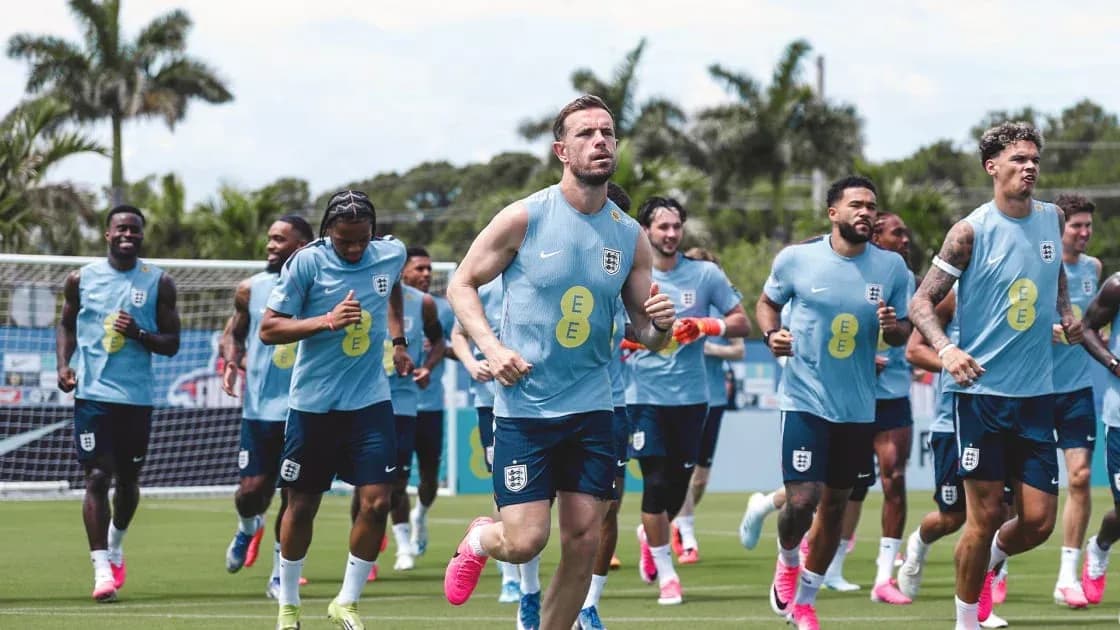
England Prepares for World Cup Heat Adaptation
Jordan Henderson insists England will grow into the searing American heat as their World Cup build-up gathers pace.
The Brentford midfielder started Saturday’s 1-0 win over New Zealand in Tampa, Florida, where the humidity wrapped around the stadium and refused to let go. Harry Kane settled it with a trademark header seconds before half-time, but this night was as much about lungs and legs as it was about the scoreline.
Thomas Tuchel treated it like a live training block, rolling out one XI for the first half and an entirely different side for the second. Henderson got the opening 45 minutes in conditions that will mirror what awaits England across the United States next summer.
“You just build your capacity to these conditions,” he told the BBC, outlining a simple plan for a complex climate. Different states, different challenges, but one clear objective: get the body used to the heat, and do it this week.
He knows there’s no perfect preparation. Temperatures and humidity swing wildly from city to city. Tampa is one thing, Texas another. Yet England’s staff have thrown themselves into the detail – cooling strategies, recovery protocols, marginal gains in every corner of the schedule.
“The warm-up games will be good for that as well and to get that exposure just best we can,” Henderson said, praising what he called an “amazing team behind the team” and the depth of research going into keeping players fresh. The hope is that those “top, top level” measures nudge England a fraction closer to an edge when the tournament starts.
Then comes the reality check: the climate doesn’t play favourites. “It’s the same for everyone,” Henderson added. The message is clear – embrace the conditions, then let the football decide.
England face Costa Rica on Wednesday in their final warm-up match, a 9pm BST kick-off that doubles as the last serious rehearsal before the World Cup opener against Croatia in Arlington, Texas, on Wednesday 17 June. That first group game, again a 9pm BST start, will give a truer indication of whether this heat adaptation work has really taken hold.
Brazil, Scotland and Norway step up their preparations
Across the Atlantic, other World Cup contenders and hopefuls were also putting down markers.
In Cleveland, Ohio, Igor Thiago led the line as Brazil edged past Egypt 2-1. Bruno Guimarães struck early, only for Mostafa Zico to wipe out the lead almost immediately. The contest reset, tight and edgy.
The pressure finally told just after the interval. Carlo Ancelotti had made eight changes at half-time, including introducing Brentford striker Thiago, and Brazil found their winner when Endrick bent a finish into the far corner from a Raphinha pass. It was a reminder of Brazil’s depth: wholesale changes, same cutting edge.
They open their Group C campaign against Morocco in New York on Saturday 13 June, an 11pm BST kick-off that will test both focus and stamina under the lights.
Further north in Harrison, New Jersey, Scotland made a statement of their own. Aaron Hickey played just over an hour as Steve Clarke’s side dismantled Bolivia 4-0, the damage done ruthlessly before the break.
Lawrence Shankland struck, Scott McTominay joined in, and Che Adams helped himself to two more as Scotland ripped through a fragile Bolivian back line. It was the sort of first-half performance that settles nerves and sharpens belief before a major tournament. Next up is their Group C opener against Haiti in Boston on Sunday 14 June, with a 2am BST start that will test body clocks as much as tactics.
On the same New Jersey turf, Kristoffer Ajer’s Norway were held 1-1 by Morocco. Brahim Díaz gave Morocco an early advantage, punishing a slow start, before Martin Ødegaard levelled after the break to steady Norwegian frustration.
Ajer, operating in the heart of defence, played 72 minutes in Harrison. Another run-out, another layer of sharpness added, in a window where every minute on the pitch matters.
From Tampa to Cleveland, Harrison to Boston, the pattern is emerging. The football is important, the results reassuring, but the real battle right now is with the climate, the travel, the rhythm of a World Cup stretched across a continent. Those who adapt fastest won’t just survive the heat of 2026; they might just define it.