England 2026: Tuchel’s Lions Aim for World Cup Glory
Sixty years of waiting. Near-misses under Gareth Southgate, scars from Moscow, heartbreak at Wembley and Berlin. Now it’s Thomas Tuchel’s turn to carry the weight of a football nation into a World Cup.
England arrive in 2026 with numbers that look almost unreal on paper. Eight qualifiers, eight wins, no goals conceded – the first European side ever to do that. Nine wins in Tuchel’s first 10 games, nine clean sheets in that spell. A 90% win rate in 2025. It reads like a machine.
The last two friendlies before the tournament, against Uruguay and Japan, reminded everyone this is still a human project, not a simulation. The doubts are real. So is the talent.
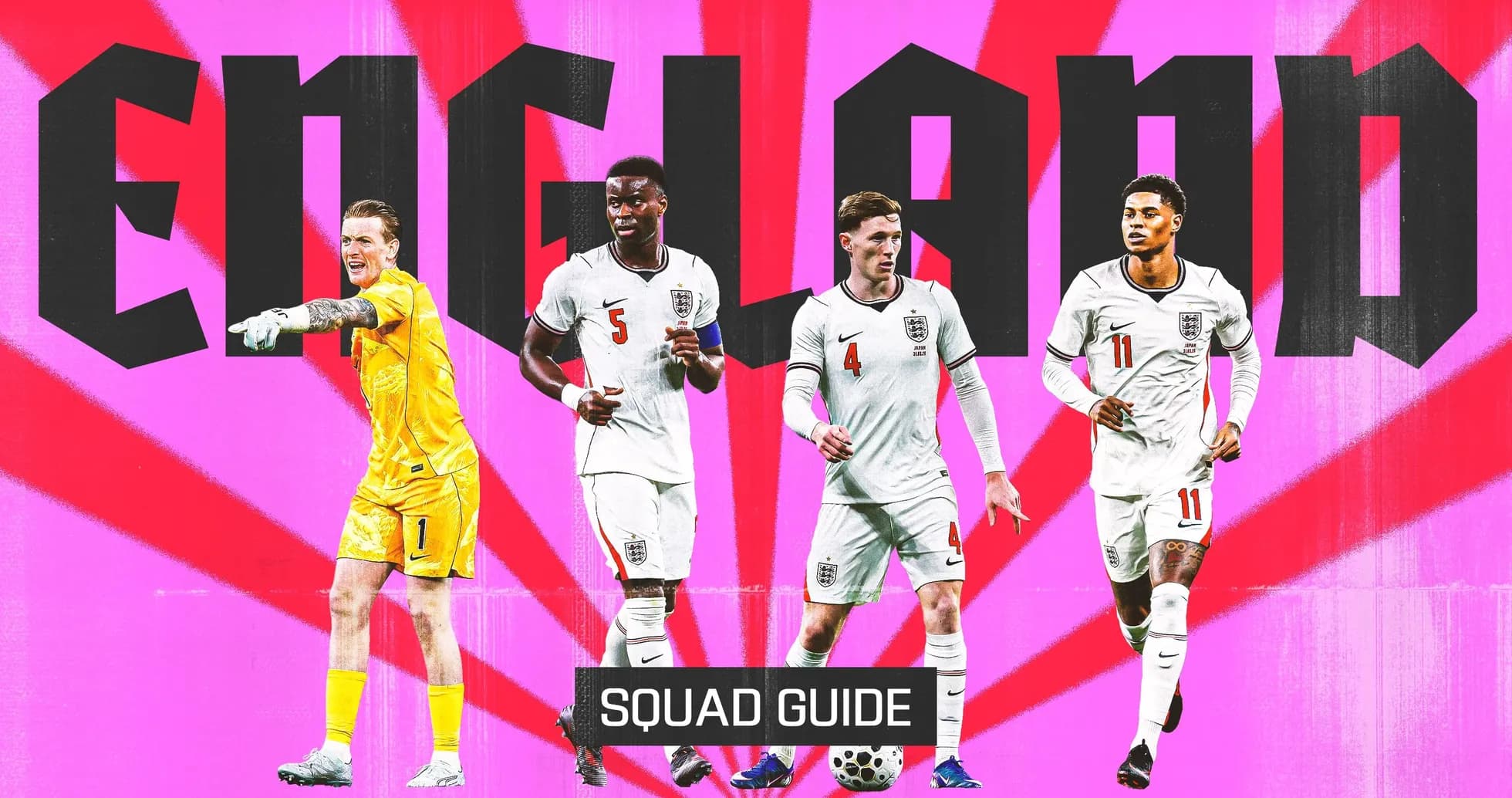
This is the 26-man group tasked with finally breaking England’s major-tournament curse.
The Manager: Tuchel the Perfectionist
Tuchel has rebuilt England in his own image: intense, structured, unforgiving out of possession. He’s matched Glenn Hoddle’s record of nine wins from his first 10 games, but with a defensive edge no England coach has ever found so quickly.
His club CV is well known – cups with Borussia Dortmund, titles and a treble with Paris St-Germain, a Champions League and Club World Cup with Chelsea, a Bundesliga with Bayern Munich. Less remembered is the origin story: a playing career ended at 24, a business administration course, waiting tables at ‘Radio Bar’ in Stuttgart to get by.
That sharp detour from the usual ex-pro pathway feeds into his management. He tolerates very little comfort. This squad has been picked to survive deep into a tournament, not just to look good on a graphic.
Goalkeepers – Pickford’s Gloves, Trafford’s Future
Jordan Pickford (Everton, 82 caps)
Tuchel called the goalkeeping battle “a race” last year. It never really was. Pickford walks into his fifth straight major tournament as England’s No.1.
He already sits behind only Peter Shilton in appearances for an England goalkeeper and has stacked up 26 major-tournament games, second only to Harry Kane. Last year he broke Gordon Banks’ record with 10 consecutive clean sheets for his country. Across the last two Premier League seasons, only David Raya has more shut-outs.
From that penalty save against Colombia in 2018 to his current streak of reliability, Pickford has gone from doubted to entrenched. This is his defence to command.
Dean Henderson (Crystal Palace, 4 caps)
Four years between his first and second cap tells the story. Henderson has had to fight for every step. Now he arrives as a genuine understudy rather than a token squad man.
He finally got another competitive England start in Albania last year and kept a clean sheet. At club level, after years of stop-start football, he’s missed just one league game in two seasons and ranks third for Premier League clean sheets in that time. His performance in Palace’s FA Cup final win – penalty save, VAR scare, big moments – felt like a personal turning point.
This is his first World Cup. He’s had to wait for it.
James Trafford (Manchester City, 1 cap)
Born into a farming family in Greysouthen, learning to drive on a tractor, teaching his relatives the offside rule – Trafford’s route to Manchester City’s goalmouth is about as far from the academy conveyor belt cliché as it gets.
He played every minute as City won a domestic cup double this season, though his league action dried up once Gianluigi Donnarumma arrived. Still, this is the same keeper who kept 29 clean sheets in 45 games at Burnley to become the first goalkeeper named PFA Championship Player of the Year.
His England debut came in March’s 1-1 draw with Uruguay. He already has a defining moment in an England shirt: that last-minute penalty save in the 2023 Under-21 Euros final against Spain. The senior stage now beckons.
Defence – Old Scars, New Shapes
Reece James (Chelsea, 22 caps)
Reece James’ England story has been a stop-start saga of brilliant peaks and brutal setbacks. Another hamstring injury in March – his tenth since late 2020 – threatened his World Cup place again. He made it back, returning against Liverpool on 9 May.
He has only one major-tournament appearance, against Scotland at Euro 2020, and missed both the 2022 World Cup and Euro 2024 through injury. Yet when fit, he’s one of the most complete full-backs in world football. His only England goal, a rasping free-kick against Latvia in 2025, showed that quality.
Now Chelsea captain and the last survivor from Tuchel’s 2021 Champions League-winning side, he carries both leadership and unfinished business.
Ezri Konsa (Aston Villa, 18 caps)
Konsa is the quiet enforcer of this back line. He played more minutes than almost any outfield England player in qualifying and equalled a 1910 record by winning 11 straight games as an England defender.
In the Premier League this season, only Virgil van Dijk has been dribbled past fewer times among defenders with 30 or more games. Konsa has also drawn more fouls than any other Premier League defender since his debut. Opponents bounce off him or trip over him; either way, he wins.
His first England goal, in Serbia last October, was a moment he said he’d “never forget”. The World Cup stage should suit his understated authority.
Marc Guehi (Manchester City, 27 caps)
Guehi arrives as a serial winner. He captained Crystal Palace to FA Cup and Community Shield glory in 2025, then lifted the FA Cup again with Manchester City this season, becoming only the fourth man to win consecutive finals with different clubs.
He scored his first England goal in that 5-0 win in Serbia and even wore the armband in March’s defeat to Japan. Born in Ivory Coast and raised in south London, where his father was a church minister and he played drums in the choir, Guehi brings a grounded presence to the squad.
He feels like a natural leader in waiting.
Tino Livramento (Newcastle United, 5 caps)
Livramento’s versatility has kept him on the plane. Right-back by trade, he’s spent almost 40% of his league minutes at left-back this season. Two of his first three England caps came in 5-0 wins, against the Republic of Ireland and Serbia, hinting at how Tuchel sees him: a high-energy, high-ceiling full-back who can flip sides when needed.
His season was disrupted by a thigh injury in April and just 14 league starts, but his profile – quick, aggressive, two-footed – fits this England back line perfectly.
John Stones (Manchester City, 87 caps)
Stones is a paradox. A cornerstone of England, a ghost at club level. He’s made just eight league starts this season and played less than half of Manchester City’s games since joining in 2016-17, missing 737 days through 32 different injuries.
Yet for England, he’s indispensable. Only Kane has more tournament appearances than his 26. He played every game in the runs to the Euro 2020 and 2024 finals and 12 World Cup matches across 2018 and 2022. Two of his three international goals came in that 6-1 demolition of Panama.
This will be his last act as a City player after 10 seasons and a medal haul that spans six league titles and a Champions League. One more summer to marshal the back line.
Nico O’Reilly (Manchester City, 3 caps)
Nico O’Reilly is the modern full-back in fast-forward. Once a classic No.10, he’s exploded this season as a marauding left-back who steps into midfield, ghosts into the box and scores big goals.
He’s played the majority of his Premier League minutes at left-back, yet also operated at left wing and central midfield. Only Erling Haaland has logged more league minutes for City this season. O’Reilly scored both goals in the EFL Cup final and started the FA Cup final.
Scouted at six, tipped as “special” by his mum when he was three months old, and a former pupil of St Patrick’s in Collyhurst – the same primary school as World Cup winner Nobby Stiles – he arrives with a sense of destiny about him.
Dan Burn (Newcastle United, 6 caps)
From collecting trolleys at Asda and £55 a game for Darlington reserves to a World Cup. Dan Burn’s story is football’s old route, not its polished academy version.
Released by Newcastle as a boy, he worked his way through Fulham, Yeovil, Birmingham, Wigan and Brighton before finally coming home. His header in the 2025 EFL Cup final etched him into Newcastle folklore as they won their first domestic trophy in 70 years.
He became one of England’s oldest debutants at 32 years and 316 days. This season he’s split his time between left-back and left centre-back, with even a brief cameo on the right. At 6ft 7in, he gives Tuchel a very different profile in defence.
Djed Spence (Tottenham Hotspur, 4 caps)
Spence arrives bruised but in. A broken jaw three days before the squad announcement couldn’t keep him out of Tuchel’s plans.
Right-footed but used mainly at left-back this season, his flexibility has finally earned him trust at Spurs after a long, frustrating wait. Signed in 2022, he had to endure three loan spells and a gap of 881 days between his debut and first start for the club.
He became the 80th Spurs player to win an England cap last September and ended this season coming off the bench in a Europa League final win over Manchester United. This call-up feels like overdue recognition.
Jarell Quansah (Bayer Leverkusen, 1 cap)
Quansah’s decision to leave boyhood club Liverpool for Bayer Leverkusen last summer raised eyebrows. For him, it was a “no brainer”. The move has paid off.
He played in 11 Champions League games in his first season in Germany and has grown into a composed, ball-playing centre-half who can also fill in at right-back. He had already been named in five England squads by three different managers before finally making his debut last November.
Earlier in 2025, he helped England’s Under-21s win the Euros. This call-up is the natural next step.
Midfield – Rice’s Engine, Bellingham’s Edge
Jude Bellingham (Real Madrid, 46 caps)
Bellingham comes into this World Cup still searching for the rhythm that made him Europe’s most devastating midfielder in 2023-24. Shoulder surgery disrupted his season at Real Madrid, and Tuchel even admitted he might have left him out of the March squad regardless of fitness.
Yet his record for England is already weighty: goals at the 2022 World Cup against Iran, and at Euro 2024 against Serbia and Slovakia. He’s played 15 major-tournament games before turning 23 and is on the brink of becoming the youngest Englishman to reach 50 caps.
Only a year ago he was driving Real to a La Liga and Champions League double with 23 goals and 12 assists, winning La Liga Player of the Season and the Champions League Young Player of the Season. If he catches fire, England’s ceiling rises with him.
Elliot Anderson (Nottingham Forest, 7 caps)
Nine months into his international career, Elliot Anderson has already become one of Tuchel’s non-negotiables. The head coach calls him “an elite football player with the right attitude and talent.” The numbers back that up.
No midfielder in the Premier League has completed more passes this season. No player has won possession more. Only James Garner has covered more distance than Anderson’s 403.5km in the league.
Raised at Newcastle, where he joined at eight, he was reluctantly sold to Nottingham Forest in 2024 to help balance the books. He’d represented Scotland at youth level up to Under-21s. Now he runs England’s midfield.
Morgan Rogers (Aston Villa, 13 caps)
Rogers has become Aston Villa’s iron man. He’s started all but one of their league games across the last two seasons and played in more matches this season than almost any player in Europe’s top five leagues, with only Newcastle’s Harvey Barnes ahead of him.
He covers ground relentlessly and has already etched his name into European history as the youngest Englishman to score in a major European final since Steven Gerrard in 2001. Under Tuchel, he’s missed just one England game before the World Cup warm-ups.
His only international goal so far, against Wales in October 2025, made him the 34th Aston Villa player to score for England – drawing them level with Manchester United for the most scorers from one club. He feels like a manager’s dream: durable, disciplined, dependable.
Declan Rice (Arsenal, 72 caps)
Rice is the constant. He has started England’s last 19 major-tournament matches and remains without a goal, but his value lies elsewhere: structure, balance, control.
His durability borders on freakish. Across eight seasons he has missed just 17 league games and only four since joining Arsenal, playing 157 of 171 possible matches. He was central to Arsenal’s title win and remains the heartbeat of this England side.
Ian Wright has gone as far as to say that if England win the World Cup, there should be a new trophy above the Ballon d’Or for Rice. Hyperbole, maybe. But it captures how central he has become.
Kobbie Mainoo (Manchester United, 12 caps)
Mainoo’s club season only really started in mid-January. Ruben Amorim resisted the clamour to pick him, but once Michael Carrick took over, everything changed. Mainoo played 15 of 16 matches under the new manager and signed a new contract through 2031.
He had already written his name into United folklore with the decisive goal in the 2024 FA Cup final against Manchester City and starred for England in the Euro 2024 knockout rounds. Then came a long international gap: no caps between September 2024 and March 2026.
Now he returns as a fully-fledged senior midfielder, with 100 United appearances already behind him. Carrick calls him “complete”. Tuchel will hope he’s right.
Jordan Henderson (Brentford, 89 caps)
Henderson turns 36 on the day England open their World Cup campaign against Croatia. He’s on the brink of history: the first Englishman to appear at four World Cups and the first to play in seven major tournaments.
His England career now stretches beyond 15 years, a feat matched only by Stanley Matthews, Peter Shilton and Wayne Rooney. Yet he has just 19 major-tournament appearances and three international goals, the last coming against Senegal at the 2022 World Cup.
He’s here as the elder statesman, the voice in the dressing room who has seen it all.
Eberechi Eze (Arsenal, 16 caps)
Eze’s first season back at Arsenal has been defined by two things: a Premier League title and a personal vendetta against Tottenham. Five of his seven league goals came against Spurs, making him only the second player to score four or more in north London derbies in a single season, after Ted Drake in 1934-35.
He arrived from Crystal Palace for £67.5m after scoring the winner in their FA Cup final triumph and has carried that big-game swagger into his England career, scoring in back-to-back qualifiers against Latvia and Serbia.
He featured off the bench at Euro 2024. This time, he feels closer to the core.
Forwards – Kane’s Charge, Saka’s Stage
Harry Kane (Bayern Munich, 112 caps)
This is the most prolific season of Harry Kane’s life. Sixty-three goals in 55 games for club and country. A career that began with a first senior goal for Leyton Orient in 2011 hit the 500-goal mark against Werder Bremen in February.
His penalty record remains absurd: 108 scored from 121, including shootouts. Since that miss against France in the 2022 World Cup quarter-final, he’s converted 47 of 50. At major tournaments, his 15 goals leave him chasing only Jurgen Klinsmann, Gerd Muller, Miroslav Klose and Cristiano Ronaldo among Europeans.
He needs three more to overtake Gary Lineker’s England World Cup record of 10 and one to move level with Neymar and Godfrey Chitalu on 79 international goals, entering the all-time top 10. For all the tactical nuance, this campaign may still come down to Kane in the box.
Marcus Rashford (Barcelona, on loan, 70 caps)
Rashford arrives with a curious record. Eighteen major-tournament appearances, but only two starts. He lit up the 2022 World Cup with three goals – one against Iran, two against Wales – yet has scored only once in his last 13 caps, a late penalty in Serbia.
On loan at Barcelona, he has rebuilt his confidence with 14 goals and 11 assists in 48 games, capped by a free-kick in El Clasico that helped secure La Liga. Hansi Flick praised his “perfect mentality” after he lost his starting spot to a fit-again Raphinha.
Rashford is used to fighting his way back into favour. He may have to do it again this summer.
Anthony Gordon (Newcastle United, 17 caps)
Gordon’s season has been split in two. In the Premier League, seven goals – four from the penalty spot – and flashes rather than fireworks. In the Champions League, he was electric. Only Kylian Mbappe, Kane and Khvicha Kvaratskhelia scored more than his 10 goals, and he became just the second player ever to score four times in the first half of a Champions League match, against Qarabag.
He has barely tasted major-tournament football, with just a two-minute cameo at Euro 2024. Yet his Champions League form has put him on Bayern Munich’s radar and forced his way into Tuchel’s plans.
If he carries that European swagger into this World Cup, he could be England’s surprise weapon.
Bukayo Saka (Arsenal, 48 caps)
Saka finally has his league title with Arsenal. The kid who carried the burden of that Euro 2020 penalty miss now walks into this World Cup as a champion and the club’s all-time leading England scorer, having overtaken Cliff Bastin’s mark of 12 with a goal against Wales in 2025.
He scored three times at the Qatar World Cup and has been a near ever-present for Arsenal, missing just three league games across three seasons before a slight dip in numbers: six league goals last year, seven this.
If he reaches 50 caps during this tournament, he’ll join Ashley Cole, Tony Adams and David Seaman as the only players to do so while at Arsenal. His own words about critics – “They’re not laughing any more” – feel like a statement of where he stands now.
Noni Madueke (Arsenal, 10 caps)
Madueke calls himself a “dual threat”, equally happy on either wing. Tuchel calls him exactly what he wants from a wide player: “fast, direct and he likes to dribble.”
His first England goal came in Serbia in October, part of a 5-0 win that showcased his fearless approach. His path has been unconventional: leaving Tottenham’s academy for PSV after a conversation between parents, winning a Dutch Cup, then moving to Chelsea and helping them to a Conference League and Club World Cup.
Now at Arsenal, he brings flair and personality, on and off the pitch. Fashion, music, football – he sees them as one. On this stage, it’s the football that matters.
Ollie Watkins (Aston Villa, 20 caps)
Watkins thought the door might be closing when he was left out of Tuchel’s 35-man squad for the March friendlies. Instead, it lit a fire. He called it “fuel in your belly to prove what you can do.”
He endured a difficult season by his own standards, with just one goal in his first 19 games in all competitions, but still maintained his remarkable run of 10 straight league campaigns with double figures. In April, he became the first Villa player in 66 years to hit 100 goals for the club.
His greatest England moment remains that stoppage-time winner against the Netherlands in the Euro 2024 semi-final. Six goals from 20 caps is a solid return. He’ll be desperate to add to it.
Ivan Toney (Al-Ahli, 7 caps)
Very few expected to see Ivan Toney’s name on this squad list. Thirty-two goals in 32 league games for Al-Ahli changed the conversation.
He has only played three minutes under Tuchel, in a defeat to Senegal last June, but his form in Saudi Arabia – 64 goals in 86 games across two seasons – is impossible to ignore. He missed out on the Golden Boot by a single goal after a final-day hat-trick from Julian Quinones.
His calling card remains penalties. Before leaving England, he’d missed just one of his last 31. In Saudi Arabia, he scored his first 24 before finally missing in February. The eight-month ban for breaking the FA’s betting rules in 2023 sits in his past. The present is a shot at redemption on the biggest stage.
Tuchel has his blend now: hardened veterans, relentless runners, gifted young technicians and a centre-forward chasing immortality. The numbers say this might be England’s most complete squad of the modern era.
The question is no longer whether they can compete.
It’s whether this group, with all its scars and storylines, is finally ruthless enough to win.