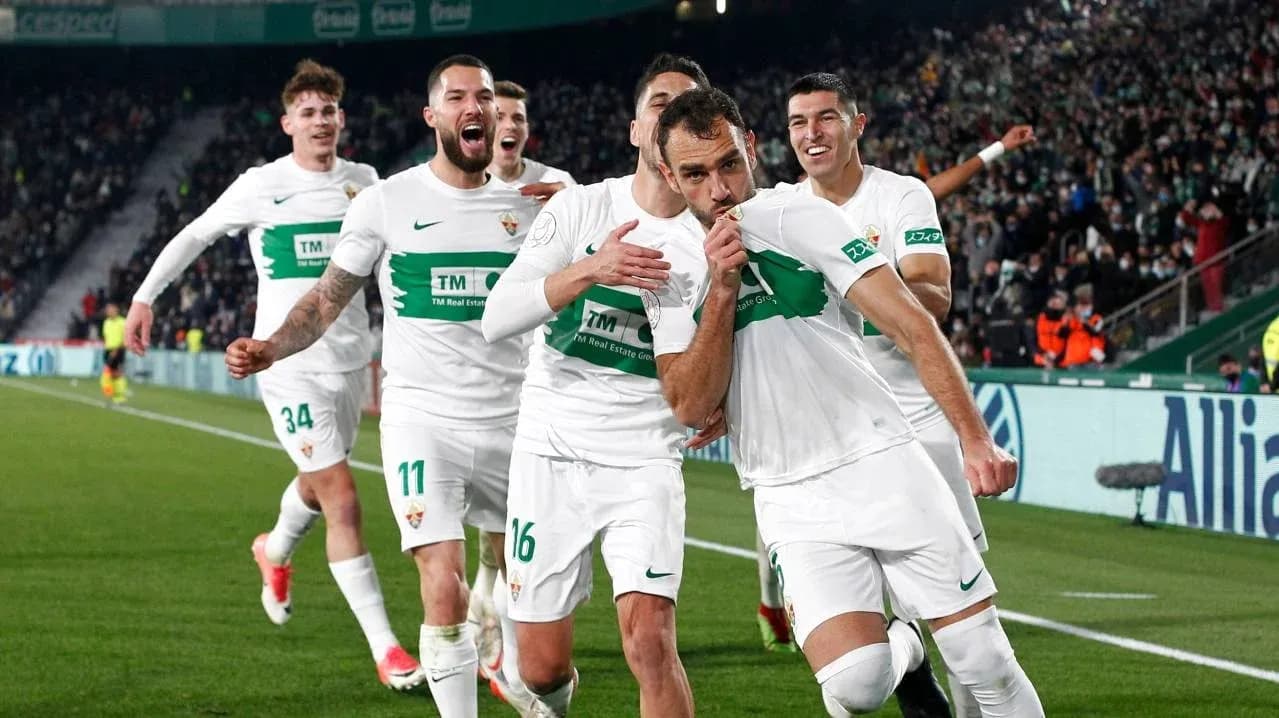
Elche and Alaves Draw 1-1: Tactical Insights from La Liga Match
Elche and Alaves shared a 1–1 draw at Estadio Manuel Martínez Valero in Round 35 of La Liga, a match defined by structural contrast: Elche’s ball-dominant 3-5-2 against Alaves’ deep 5-3-2 and direct transitions. The scoreline reflects a tactical arm-wrestle where Elche controlled territory and rhythm, while Alaves created the higher-quality chances and threatened most when breaking Elche’s rest-defense. Both coaches, Eder Sarabia and Quique Sanchez Flores, stayed faithful to their base shapes but used substitutions aggressively in the second half to adjust pressing height, wing dynamics, and central occupation.
I. Executive Summary
Elche finished with 65% possession, 464 passes at 87% accuracy and a 1.46 xG profile, but needed a second-half surge and bench impact to cancel out a 51' penalty from T. Martinez. A. Rodriguez’s 72' equaliser, assisted by Josan, rewarded Elche’s sustained pressure and wider occupation against a compact Alaves back five. Alaves, with just 35% of the ball and 250 passes (75% accuracy), produced 2.14 xG, reflecting how their counter-attacks and penalty-box presence were more incisive than their build-up. Goalkeepers M. Dituro and A. Sivera both finished with 0.81 goals prevented, underlining a game where both defensive blocks were periodically exposed but rescued by key interventions.
II. Scoring Sequence & Disciplinary Log
Card verification (locked totals):
- Elche: 3 yellow cards
- Alaves: 6 yellow cards
- Total: 9 yellow cards
Disciplinary log (chronological, exact reasons):
- 12' Pablo Ibáñez (Alaves) — Foul
- 29' Antonio Blanco (Alaves) — Foul
- 33' Jonny Otto (Alaves) — Foul
- 50' Aleix Febas (Elche) — Foul
- 69' Ibrahim Diabaté (Alaves) — Foul
- 78' Antonio Sivera (Alaves) — Argument
- 88' Grady Diangana (Elche) — Argument
- 88' Abderrahman Rebbach (Alaves) — Argument
- 90+5' John Donald (Elche) — Foul
Scoring sequence (chronological):
- 51' T. Martinez (Alaves) — Penalty
- 72' A. Rodriguez (Elche), assist Josan — Normal Goal
The first half, goalless at 0–0, was marked more by Alaves’ early disciplinary issues than by clear chances. Pablo Ibáñez, Antonio Blanco, and Jonny Otto all went into the book for “Foul” before the 34th minute, a direct consequence of Alaves’ aggressive midfield and wing-back duels as they tried to disrupt Elche’s possession game. The deadlock broke on 51' when Alaves won and converted a penalty through T. Martinez, shifting the match into a more open tactical phase.
Elche responded with a double substitution on 67', introducing Josan and G. Diangana for Tete Morente and A. Febas, immediately changing the right flank’s dynamics. Simultaneously, Alaves replaced scorer T. Martinez with Yusi, signalling a more conservative, defensive tilt. Just five minutes later, at 72', Elche’s pressure paid off: A. Rodriguez equalised from open play, assisted by Josan, who exploited space against a tiring Alaves wing-back unit.
The final quarter-hour was fragmented and heated. Ibrahim Diabaté’s “Foul” yellow at 69' foreshadowed the rising tension; later, Antonio Sivera was booked for “Argument” at 78', and in the 88' minute, both Grady Diangana and Abderrahman Rebbach received yellow cards for “Argument” in a flashpoint incident. In stoppage time, John Donald’s “Foul” booking at 90+5' closed a disciplinary ledger that reflected Alaves’ reactive, high-contact approach and Elche’s late emotional surge.
III. Tactical Breakdown & Personnel
Elche’s 3-5-2 under Eder Sarabia was built on structural dominance. With three centre-backs (V. Chust, D. Affengruber, P. Bigas) and a five-man midfield, Elche could consistently form a 3-2 base in build-up: the central trio of G. Villar, M. Aguado, and A. Febas offered interior triangles, while Tete Morente and G. Valera stretched Alaves’ back five horizontally. The 65% possession and 464 passes at 87% accuracy show how effectively Elche circulated the ball, especially into the half-spaces.
However, Elche’s 1.46 xG from 16 shots (5 on goal, 14 inside the box) reveals a recurrent issue: volume without elite shot quality. The front pairing of A. Rodriguez and Andre Silva often received to feet with backs to goal, forced into contested shots through crowds. Alaves’ compact 5-3-2 narrowed central channels, pushing Elche wide and into crosses or low-percentage cutbacks.
The key structural adjustment came on 67' when Josan (IN) came on for Tete Morente (OUT), and G. Diangana (IN) replaced A. Febas (OUT). This shifted Elche’s right side from a more balanced wing-back to a pure wide threat. Josan’s verticality and crossing immediately targeted the space behind A. Perez and the right-sided centre-back. The 72' equaliser encapsulated this: Josan attacked the flank, delivered into the box, and A. Rodriguez finished, finally converting territorial control into a decisive action in the penalty area.
Defensively, Elche’s “Defensive Index” was mixed. They allowed 12 shots (11 inside the box) and 2.14 xG despite controlling the ball. This underlines a vulnerability in defensive transitions: when possession was lost, the wing-backs were high, and the three centre-backs were often left to defend large spaces against the Alaves front two and arriving midfielders. M. Dituro’s 3 saves and 0.81 goals prevented show he had to bail out that high line several times.
Alaves’ 5-3-2 under Quique Sanchez Flores was unapologetically reactive. With A. Rebbach and A. Perez as wide defenders and N. Tenaglia, V. Parada, and Jonny Otto forming the core of the back five, Alaves compressed the central lane and accepted Elche’s wide overloads. Their offensive plan was clear: use I. Diabate and T. Martinez as vertical outlets, with P. Ibanez, Antonio Blanco, and J. Guridi stepping forward selectively to support breaks.
Despite just 35% possession and 250 passes (75% accuracy), Alaves’ 2.14 xG and 4 shots on goal from 12 total shots show that when they reached the final third, they did so with numbers and intent. The penalty at 51' was emblematic: quick progression, forcing Elche’s defenders into desperate actions in the box. Ibrahim Diabaté’s booking for “Foul” at 69' and his substitution at 82' for C. Protesoni (I. Diabate OUT, C. Protesoni IN) reflected both his physical influence and the risk profile of Alaves’ direct play.
Antonio Sivera’s role was pivotal. With 4 saves and 0.81 goals prevented, he matched Dituro in shot-stopping impact but under heavier territorial pressure. His “Argument” yellow at 78' also hinted at the psychological strain of constant defending. Late changes — A. Guevara for J. Guridi and A. Manas for A. Rebbach — were aimed at refreshing legs in midfield and the back line, trying to preserve the point as Elche pushed.
IV. The Statistical Verdict
From a data and season-profile perspective, the draw masks contrasting performance patterns. Elche’s Overall Form in this match aligns with a possession-first side: high passing volume, strong completion, and a moderate 1.46 xG, but a Defensive Index that allowed 2.14 xG despite territorial control. Their 7 corners to Alaves’ 3 and 0 offsides underline sustained attacking occupation, yet the need for a bench-driven solution (Josan’s assist, Diangana’s involvement and later booking for “Argument”) suggests their starting structure lacks enough penetration against deep blocks.
Alaves’ Overall Form here is that of a resilient, counter-punching side: fewer fouls (13 vs Elche’s 15) but many more yellow cards (6 vs 3), pointing to the intensity and risk in their duels. Their Defensive Index is paradoxical — they conceded 16 shots and heavy territory but limited Elche to 1 goal and 1.46 xG, thanks to compact spacing and Sivera’s 0.81 goals prevented. Offensively, generating 2.14 xG with just 35% possession is highly efficient and suggests that, structurally, their transition mechanisms and penalty-box occupation are more dangerous than their build-up.
In pure tactical terms, Elche won the territory and structure battle; Alaves won the efficiency and chance-quality battle. The 1–1 scoreline, with exact card totals of Elche 3 and Alaves 6, ultimately reflects a clash of styles where neither side fully solved the other’s core identity.