
Eddie Howe's Newcastle: A Season of Struggles and Change
Eddie Howe walked alone.
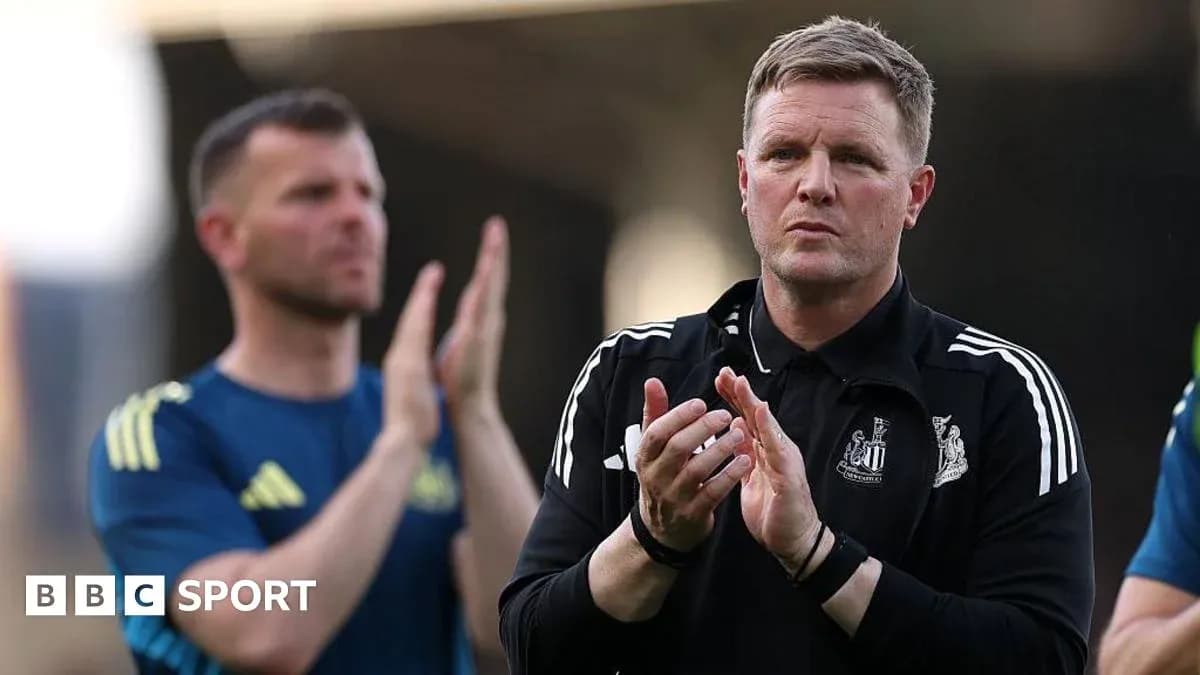
Newcastle United’s head coach set off on the traditional lap of appreciation at St James’ Park after the final home game of the season, but he never truly felt solitary. The sound wrapped around him. “Eddie Howe’s black and white army” rolled down from the stands again and again, the same anthem that had framed Champions League qualification in 2023 and 2025.
This time, though, it hit differently.
Newcastle had just taken seven points from nine to drag some late-life into a bruising campaign. The stadium stayed. The applause lingered. The reception stuck with Howe because this, by his own admission, had been his hardest season on Tyneside. The goodwill felt like a reminder of what he had built – and a warning of what he could yet lose.
There was still one game left. And one more wound to take.
From momentum to malaise
Fulham away on the final day was supposed to be a quiet exit. Instead, it was a grim reprise. Newcastle, flat and familiar in all the wrong ways, slipped to a 2-0 defeat – their 17th league loss of the season.
Heads dropped as players and staff trudged towards the away end at full-time. The scene had a weary déjà vu about it. Groundhog Day in black and white.
“There have been a lot of bruises this season,” Howe said afterwards. That barely scratched the surface.
By then, the hierarchy had already moved into crisis-analysis mode. Earlier in May, owners, executives and senior figures gathered in Northumberland for their annual summit. This year, the agenda bit harder.
“We are in a moment right now and they want to understand why, what we are doing about it and how to fix it,” a senior source said.
Emotion has been parked. In its place: cold, detailed assessment of what has gone wrong and how to repair it. The conclusion is stark. Big changes are coming. This squad will not look the same when next season kicks off.
A squad on the brink of change
Anthony Gordon sits at the centre of that shift. Newcastle and Bayern Munich remain apart on valuation, and the club insist any sale will be on “our terms”, but the winger looks increasingly likely to be among those cashed in.
If he goes, he will not be alone. Once the outgoings are factored in, Newcastle expect to need a goalkeeper, a full-back, a midfielder and at least a couple of forwards just to give Howe a workable base.
The manager, worn down by recurring on-field problems he has not been able to solve, has been blunt about the scale of the job. After a 12th-placed finish that fell well below internal expectations, he says the club are “very clear” on what is required this summer.
New faces will not be enough on their own. Howe knows that. But he also points to examples across the league of clubs vaulting up the table off the back of one outstanding window. This rebuild, led by sporting director Ross Wilson, is designed with that kind of jolt in mind.
Crucially, Howe is seen not just as part of the problem but part of the cure. That matters. This is the coach who, only last season, ended a 70-year wait for a major domestic trophy by delivering the Carabao Cup. He has credit in the bank.
Yet standards have slipped. Everyone inside the club accepts that this campaign has not been good enough. Just as Newcastle’s performances have veered wildly from week to week, Howe himself has often looked like a man scrambling for a formula.
The bar has to be reset after his worst domestic season in charge.
“It’s something we need to address and we need to address it very quickly,” he said. He is right. Newcastle have lost their edge.
From ruthless to brittle
Not long ago, this side finished teams off. In 2024-25, no one in the Premier League surrendered fewer points from winning positions than Newcastle – just seven. The pattern was simple and brutal: Alexander Isak would strike first or drag them back into games, and a well-drilled unit would lock the result down.
Then came the protracted, £125m sale of Isak to Liverpool. The safety net went with him.
This season, the numbers tell an unforgiving story. Newcastle have thrown away more points from winning positions (27) than any other top-flight side. They have conceded more goals (21) in the final 15 minutes than anyone else. A team once defined by its ferocity has become flaky.
The workload has played its part. Unlike Europa League winners Aston Villa, who crashed out of both domestic cups relatively early, Howe’s side tried to juggle multiple fronts for much of the season. The strain showed. Even when the schedule eased late on, the extra training and recovery time did not translate into a sustained revival. There were flickers of evolution, but nothing that stuck.
For many in the dressing room, this was their first taste of a 58-game, mentally draining campaign. “Bloody hell, it’s not easy,” a source close to one regular admitted. That fatigue seeped into every corner of the club. Even the coaching staff felt they could not enjoy wins properly, always glancing nervously at the next fixture that might flip the mood again.
Newcastle never found the kind of defining run that had powered them in previous seasons. They lived on the wrong side of fine margins: 71% of their league defeats came by a single goal. Howe has to drag them back into the habit of landing on the right side of those moments.
Patience with an expiry date
In the stands, there is an understanding of the context – the injuries, the schedule, the upheaval. But there is also a limit.
Season-ticket holder Liam Phillips believes the club needs a “reset”. His warning is pointed.
“He badly needs a good start next season,” he said of Howe. “If Newcastle are not in the top six or seven in the first few games, I think the crowd will quickly turn.
“There has been a patience and understanding this season but if the team start badly after spending more money in the transfer market, I don’t think people will be quite as forgiving.”
That is the tightrope Howe now walks. The owners must get this summer right after a turbulent window a year ago that left scars.
Back then, Newcastle missed out on a string of first-choice targets. Most of the players they did sign arrived late. There was no chief executive, no sporting director in place. The structure creaked. On deadline day, after months of resistance, they buckled and sold Isak. The decision still hangs over them.
Clubs such as Brentford and Bournemouth have shown it is possible to sell key players and rebuild smartly. Newcastle have not yet done the same. A net spend north of £100m last summer, with Howe heavily involved, has not yielded enough. Only defender Malick Thiaw can be called an unqualified success.
The Howe way – and its toll
The relentless calendar from September to March left little room for the intense, on-grass schooling Howe prefers. New arrivals had to adapt on the fly, leaning heavily on analysis sessions rather than the physical immersion he believes in.
Jacob Ramsey’s experience was typical. He had only a short window to feel the full force of Howe’s methods before the games stacked up. Even in that spell, the midfielder was said to have been jolted by the level of high-intensity running demanded in drills, despite coming from Unai Emery’s demanding set-up at Aston Villa.
It was a snapshot of the adjustment every newcomer faces at Newcastle. Howe hopes that last summer’s signings will be stronger for it, better equipped to deliver when the slate wipes clean.
He has, in the past, built teams that punch above their wage bill. This time, his side finished in the bottom half. While Sunderland seized the moment in their own season by beating Newcastle home and away and booking a European spot in a year when eight places were available, Howe’s men fell short of the continental cut.
The boom-and-bust cycle cannot continue. Howe has thrived when he has had extended clear weeks to prepare his team for league fixtures. He needs that rhythm again, and he needs a squad capable of absorbing his demands.
“Every experience makes you stronger and makes you appreciate the good times,” he said. “We will all try and come back a better team.”
The lap of appreciation in May hinted the city still believes him. The question now is whether, after one brutal season and one critical summer, they will be walking that circuit together next year – and what they will be applauding.



