
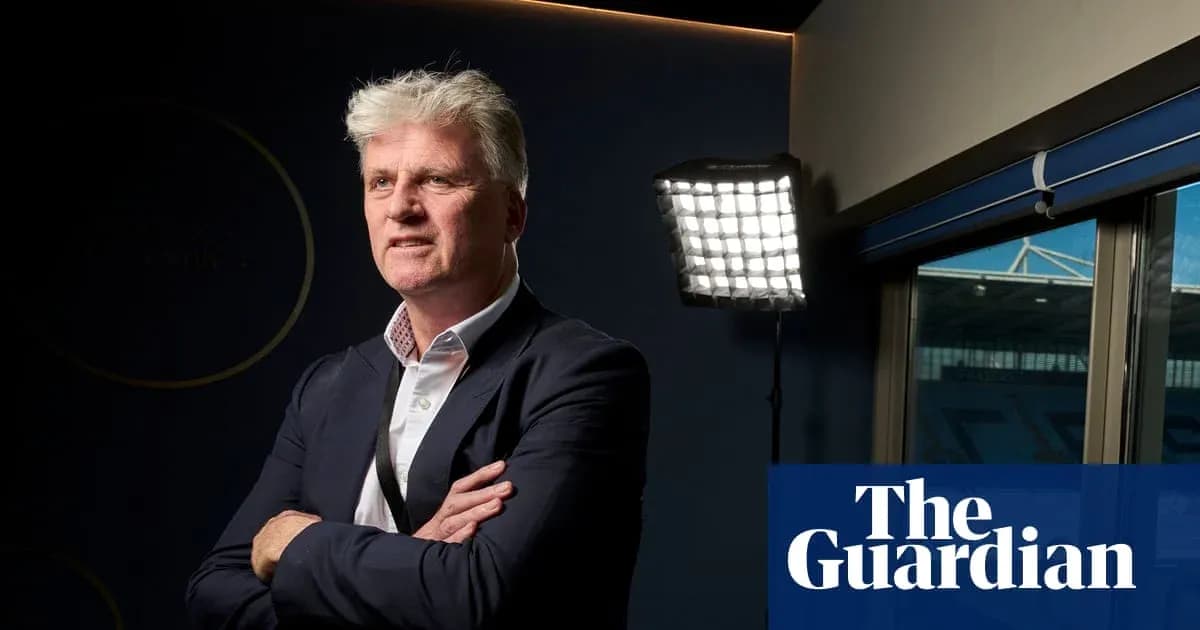
Doug King's Journey: From Travelodge to Premier League Success
Doug King didn’t celebrate promotion to the Premier League in a Mayfair penthouse or a private jet at 30,000ft. He ended up in a Travelodge by a service station on the M65, the sound of delirious Coventry fans still ringing in his ears.
“It was… noisy,” he says, pausing for effect. All night, the soundtrack was the same: “We are Premier League.”
For Coventry City, back in the top flight after 25 years, that noise has barely stopped.
From service station to street party
King has found himself cast as Coventry’s unofficial master of ceremonies. The biggest occasion yet came on Monday, when an open-top bus rolled out along Jimmy Hill Way, the road named after the manager who first took the club into the top division in 1967.
This time, the man at the centre of it all was the straight-talking owner with a background in grain and petroleum trading, a mathematical engineering graduate who completed a 100% takeover in January 2023 and promptly set a five-year plan for promotion.
They did it in 18 months.
When Coventry were crowned champions last month, King drank from the trophy. Literally. “I didn’t think the lid would come off, so we had to make the most of that,” he says, grinning. It’s the kind of detail that has made him feel less like a distant financier and more like a fan who happened to make hundreds of millions and decided to spend a chunk of it on his club.
His early pitch to supporters was bold. He offered 5,000 of them a premium five-year “Premier League package”, dangling the promise of a free season ticket if they stuck with it and promotion arrived in that window. Commit. Believe. Get rewarded.
“If you did one year and said: ‘Well, they’re never going to get there,’ then you missed out.”
They got there.
The near-misses and the earthquake
The journey has not been smooth. Before Frank Lampard’s arrival and the surge to the title, Coventry had flirted with promotion and felt the sting of failure. Last season’s playoff semi-final defeat by Sunderland still sits raw.
Lucas, one of King’s five children, couldn’t even watch the corner from which Dan Ballard headed Sunderland’s late winner. He covered his face with his tie. Seconds later, the ball was in the net and the dream was gone.
“That hit hard, that last-minute kick in the face,” King says. “It was like an earthquake, the ground was just shaking: ‘Oh my God, everyone’s going to be devastated.’”
That devastation shaped what followed. Eighteen months after Lampard walked into King’s Pall Mall offices for his interview, Coventry were not just promoted; they were champions, the scars of Sunderland turned into fuel.
Owning the ground, owning the future
One of King’s defining moves came away from the touchline. In August, he signed off a £50m deal to buy the CBS Arena, ending almost two decades of life as tenants and the constant uncertainty of landlords and leases.
“A big moment to just close the chapter of the club and its ground, once and for all,” he calls it.
On the day the deal went through, everything seemed to align. Coventry thrashed QPR 7-1 at home. Symbolism doesn’t come much louder.
“It was fitting, really: ‘OK, everything’s together now, the team’s really good, let’s see where we can take it.’”
That “we” matters. King has made a point of being present, visible, and accountable. He fronted up when he sacked Mark Robins, the manager who had taken Coventry from League Two to within a penalty shootout of the Premier League. It was a brutal call on a club hero, but King didn’t hide.
“In business, I have delegated major projects to teams, to CEOs, where I’d been a bit disappointed,” he says. “You delegate, you have your big, fat budget, they get on with it, and then you hear the bad stuff too late.
“For me, this was too important for that. This was my moment to be all over it. I wanted to make a contrast to the previous incumbents, the hedge fund [Sisu] in Mayfair: ‘We’ve got some leadership here, this is what we’re gonna do.’”
The owner who sings in the stands
King does not sit in a glass box and watch in silence. He belts out The Enemy’s “We’ll Live and Die in These Towns”, the club’s unofficial anthem, with the rest of them. When the Coventry-born band played it pitchside in November and then again on stage at War Memorial Park during the promotion parade, it hit him harder than he expected.
“It was way more special than I thought it would be – it just felt very intimate and very real,” he says. “And I think we want to do different things. I don’t want to be boring. I think a club has to stand for more than just the products necessarily on the pitch.”
That sense of connection has fed into his popularity. Supporters chant his name. Two of them even turned up dressed as him – lanyards, sky-blue ties, bouffant wigs – and tried to bluff their way into the boardroom.
“I did give them a shoutout as I was walking around,” King laughs. “They tried to blag themselves into the boardroom, they had the credentials on, but I’m way more handsome than them …”
What sets him apart is not just the jokes. It’s the accessibility.
“Maybe you can be intimidated, you know: ‘The owner, the big owner,’” he says. “Listen, I’m a human being. I’ve earned some money. I’ve decided to deploy it into a project, which is a dangerous thing to do, actually, for your wealth. I should feel accessible. If it isn’t going well, say you don’t think that was very good, no problem.”
From St Andrews to Seve to Sky Blue
This is not King’s first brush with elite sport. Long before he was buying football clubs, he was lugging golf bags around St Andrews.
He grew up in Lowestoft, captained Loughborough University’s golf team, then worked as a caddie. In 1986, at the Dunhill Cup, he carried the bag for Ronan Rafferty, who would go on to win the European Tour Order of Merit and play in the Ryder Cup.
Rafferty, representing Ireland, faced Spain and Seve Ballesteros on the Old Course. King, still a teenager, found himself inside the ropes with Europe’s No 1.
“Can you imagine? I’m on the old course caddying against Seve, who was No 1 in Europe: ‘OK, better not make any mistakes today.’ And we hammered him. I say we, I felt like it was we. Ronan shot 67 and Seve was grumpy and finished with 74.”
That taste of the top level, the requirement to make clear decisions under pressure, has never really left him.
Lampard, “shockers” and second acts
When King sat down with Lampard in Pall Mall, he wasn’t just hiring a name. He wanted a team. Lampard arrived with trusted lieutenants Joe Edwards and Chris Jones, and that, for King, was crucial.
“I was happy that he was coming in with people that he trusted, because I think coming in on a solo mission and seeing what you’ve got is trickier,” King explains. “Because whenever you come in with his reputation and who he is, most people will tiptoe around the tulips. It’s always the way, right? Are you going to get proper feedback?
“I like that he came in with a close-knit team that he’d been successful with, and they could counter and balance him and he felt comfortable in that. I had no doubt he would do well, but I have been impressed with him and how it’s gotten under his skin.”
King recently admitted he likes “people who have had a few shockers”. Lampard fits the brief. Sacked by Everton inside a year, then given what he describes as a “babysitting” role at Chelsea, he arrived in Coventry with his reputation bruised and his methods questioned.
King saw opportunity, not baggage.
“I look at those things more as a positive,” he says. “He will have had to handle some pretty dysfunctional messaging, let’s put it like that. Those sorts of things make you uncomfortable, but you have to find solutions to get by. So he’s been in areas that make you grow as a leader, as a motivator, as a coach.”
Lampard’s contract runs until next summer. Asked if steps are being taken to extend it, King sidesteps specifics but not the bigger picture.
“Listen, it’s worked well,” he says. “He put himself back into the arena and everybody sort of said: ‘OK, it’s Frank again, let’s see what happens here. He will probably near-miss it or it won’t go well,’ so there was quite a bit of pressure on him.
“He felt confident with his team that he could get clarity, motivation, focus, to take the club towards some form of success. Did he think we would be champions 18 months later? I don’t think so. Nor did I.”
A Premier League plan, without the script
The party will die down. The parade buses will be parked up. The songs will soften. Then the hard part starts.
“People might go: ‘If you finish 17th, it’s all good, and you go again,’” King says. “Yeah, OK, but maybe I want to look at different things: can we be a bit better?”
He has watched how Bournemouth, Brentford and Brighton have not just survived in the Premier League but embedded themselves, grown, and punched above their weight. Their examples give him confidence, but he refuses to rush out grand promises.
“I like doing what I say we’re going to do,” he says. “I haven’t said what we’re going to do in the Premier League because I haven’t formulated exactly how I’m going to attack it. But, clearly, it would be to try and stay in there, build momentum to get into the top half and, yeah, once every blue moon, maybe have a nibble into heading into playing in different countries.”
He knows the risks. He knows the scrutiny will sharpen. He insists he will carry the responsibility.
“As the leader of Coventry City, I will work it all out and I’ll put together a strategy and if it’s an absolute shocker, then I guess I’ll take the blame.”
For now, the image lingers of a wealthy owner in a budget hotel off the M65, listening to fans roar his club’s new reality through the Lancashire night.
The Travelodge will be swapped for trips to Anfield, the Etihad and Old Trafford soon enough. The question is no longer whether Coventry can get to the Premier League.
It’s how far Doug King and Frank Lampard can take them now they’re finally back.



