Como’s Tactical Mastery Secures 2–1 Victory Over Cagliari
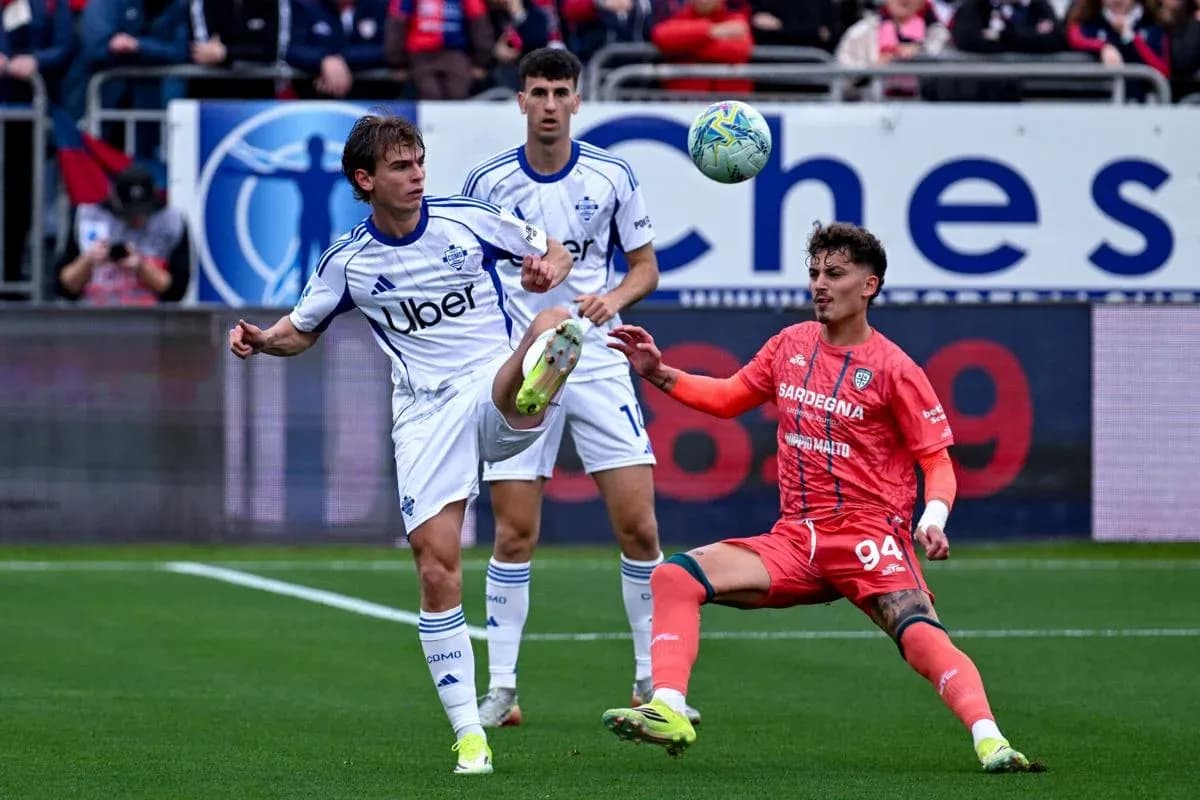
Cagliari 1–2 Como: possession control and compact defending underpin Como’s away win at Unipol Domus
The battle: possession flow and territorial control
Como’s 2–1 away win was built on a clear territorial plan. With 57 percent of the ball and 493 passes at 83 percent accuracy, Cesc Fabregas’ 4‑2‑3‑1 prioritised stable circulation through the double pivot of M. Perrone and L. Da Cunha, then later through Da Cunha plus the rotated midfielders. Cagliari’s 43 percent share and 364 passes at 78 percent accuracy show a more direct 4‑3‑3, looking to break from a mid‑block rather than dominate the ball.
Despite trailing in possession, Cagliari actually turned phases of pressure into more penalty‑box activity: four shots inside the box to Como’s four, but with a more chaotic, second‑ball driven pattern rather than structured entries. Como’s control was more about where the game was played than pure volume of attacks.
Offensive mechanics: efficiency over volume
Both sides finished with eight total shots, underlining how even the shot count was despite Como’s territorial edge. Cagliari generated three shots on target from those eight and a scoring threat of 0.46, converting once via S. Esposito on 56 minutes after A. Obert’s delivery from the left. Como produced only two shots on target but a slightly higher scoring threat of 0.55, again scoring twice.
That efficiency gap defines the game plan. Como did not chase volume; instead, they engineered high‑value moments. The 14‑minute opener from M. Baturina, assisted by Da Cunha, came from exploiting Cagliari’s advanced full backs in transition. The 76‑minute winner by Da Cunha, set up by I. Van der Brempt, again targeted the right flank, with the full back overlapping into space left by Cagliari’s aggressive wide forwards.
Blocked shots highlight defensive density: Cagliari had four shots blocked by Como, while Como had three shots blocked by Cagliari. Como’s higher block count against them indicates a compact box defending phase once they had the lead, especially after 76 minutes, whereas Cagliari’s blocks reflect more emergency defending against controlled Como entries.
Defensive intensity: fouls, cards and work under the bar
The foul count (18 by Como, 17 by Cagliari) shows a physically balanced contest, but the card profile is telling. Cagliari received three yellows: Marco Palestra on 65 minutes and Sebastiano Esposito on 71 minutes, both for simulation, signalling growing attacking frustration and a search for marginal gains in the box. Alberto Dossena’s 89‑minute yellow for a foul reflects late‑game desperation to stop transitions.
Como, by contrast, received a single yellow card, Jacobo Ramon on 83 minutes for a foul, consistent with game‑management fouling as they protected the lead. Under the bar, J. Butez made two saves, while E. Caprile registered none, another indicator that Como’s attacks were fewer but cleaner, and Cagliari’s finishing either missed the target or was blocked before reaching goal.
Substitution phases and tactical shifts
The first key shift came at 36 minutes, when Como replaced M. Perrone with M. Vojvoda. This early change effectively morphed the structure into a more asymmetric back five in build‑up, with Vojvoda offering extra stability on the flank and freeing Van der Brempt to advance more aggressively later, a pattern that culminated in his assist for the 76‑minute winner.
At 62 minutes Como introduced Alvaro Morata for A. Douvikas. This was a clear move to secure first contact and hold‑up play. Morata’s profile allowed Como to play longer under pressure, relieve Cagliari’s press and keep the defensive line pinned, even though he did not score.
The 73‑minute substitution for Cagliari, G. Zappa for J. Pedro, was an attempt to inject more attacking thrust from right back, pushing Zappa high to create a 2‑3‑5 in possession. However, this also exposed the channels, which Como exploited on turnovers.
The triple substitution on 78 minutes for Cagliari (R. Idrissi for J. Rodriguez, S. Kilicsoy for J. Liteta, and Y. Trepy for S. Esposito) represented an all‑in attacking reshuffle. Idrissi added width, Kilicsoy fresh vertical runs, and Trepy a different profile up front. Yet this came immediately after Da Cunha’s 76‑minute goal, so the changes were reactive, chasing a deficit rather than shaping the match. The late 88‑minute introduction of L. Pavoletti was a final aerial gamble, aiming for direct crosses, but Como’s compact box and Butez’s command nullified this route.
Como’s own late changes at 80 and 81 minutes were about game management. Diego Carlos for N. Paz at 80 minutes and A. Valle for A. Moreno plus S. Roberto for Baturina at 81 minutes rebalanced the side with fresh defensive legs and an extra controlling midfielder. Removing Baturina, already a scorer, signalled a shift from creative risk to ball retention and defensive solidity between the lines.
Conclusion: control, structure and marginal gains
The 1–2 scoreline, with Cagliari at home and Como away, reflects a contest where possession control, not shot volume, dictated the outcome. Como’s slightly higher scoring threat, superior pass accuracy, and more disciplined card profile point to a coherent, risk‑managed plan: dominate where the game is played, accept parity in shot volume, and trust efficiency in key moments. Cagliari’s 4‑3‑3 produced phases of pressure and a flurry of blocked efforts, but the reliance on individual surges and late structural gambles left them exposed to precisely the kind of transitional attacks that Como were set up to punish.