Barcelona's Tactical Control in 1–0 Win Over Rayo Vallecano
Barcelona’s 1–0 win over Rayo Vallecano at Camp Nou was a controlled, structurally coherent performance built on territorial dominance and a well-drilled 4-2-3-1, but also one in which efficiency in both boxes nearly betrayed them. Despite leading in possession (61–39), total shots (15–8) and passing accuracy (86–76), Barcelona’s xG of 1.39 versus Rayo’s 1.56 underlines how fine the margins were and how often the visitors reached genuinely dangerous zones.
Defensive resilience was high on both sides: Barcelona saw 5 of their shots blocked, while Rayo Vallecano had 1 attempt stifled by the opposition. With both teams registering 4 shots on target, the difference came from Barcelona’s early set-piece execution and then their ability to compress space in front of J. Garcia, who finished with 4 saves in a game where his defense limited clear second-phase chances.
Team Structures
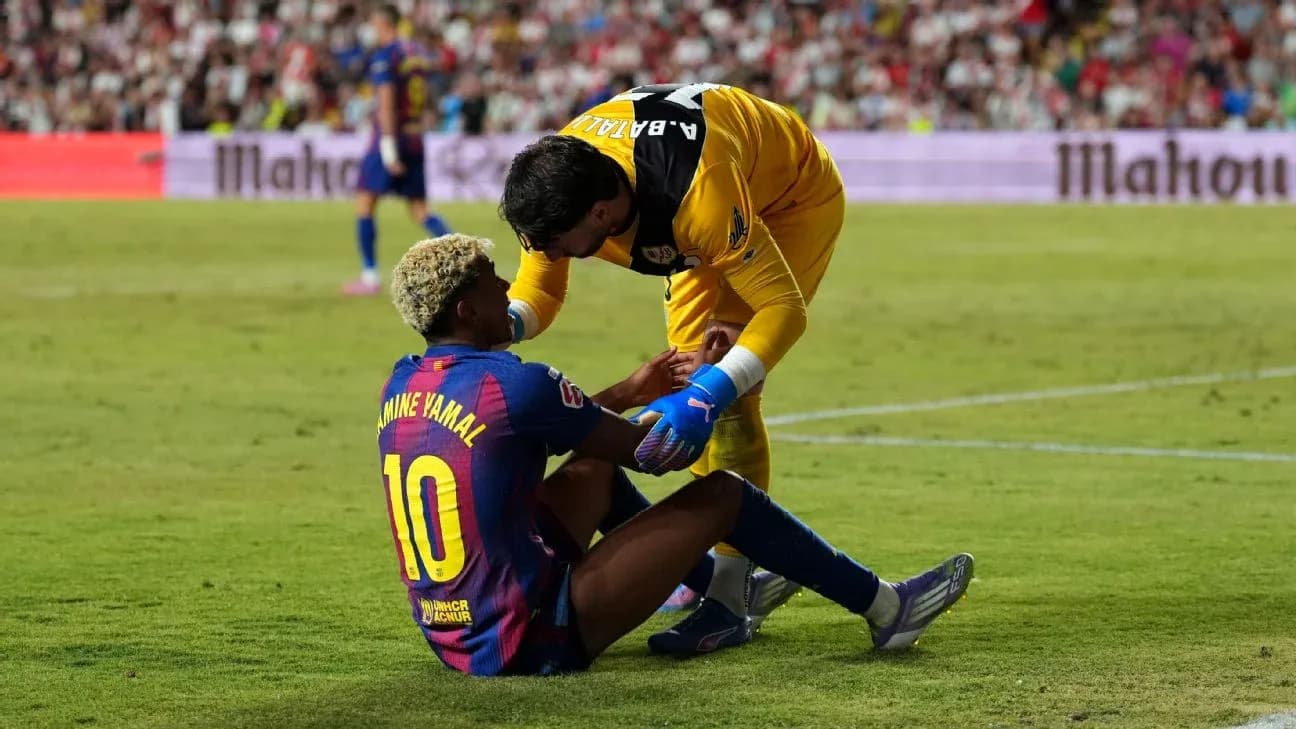
Structurally, Hansi Flick mirrored Rayo’s 4-2-3-1, but the internal mechanics were very different. For Barcelona, M. Bernal and Pedri formed the double pivot, with Bernal (shirt 22) more anchored and Pedri (8) stepping higher to connect with the line of three: Lamine Yamal (10) right, Fermín (16) central, Raphinha (11) left, behind R. Lewandowski (9). The full-backs J. Cancelo (2) and G. Martin (18) played aggressively, often forming a back three in possession with P. Cubarsi (5) and R. Araujo (4) as Cancelo inverted into midfield lanes.
The decisive moment came from that structural boldness. At 24', a set-piece situation saw R. Araujo attack the box from his right-sided centre-back zone and finish after a delivery from J. Cancelo. The goal reflected Barcelona’s emphasis on loading the penalty area with both centre-backs when Rayo were forced to defend deep. With 10 of Barcelona’s 15 shots coming from inside the box, their positional play did succeed in creating presence in the area, even if the finishing and final pass were often rushed.
Pressing and Defensive Actions
Out of possession, Barcelona’s press was front-footed but not reckless. R. Lewandowski acted as the first trigger, curving his runs to block central access to P. Diaz (4) and Óscar Valentín (23), forcing Rayo to build through the full-backs A. Ratiu (2) and P. Chavarria (3). When the press was broken, Bernal dropped into the back line to form a temporary three, with Cancelo and G. Martin narrowing to protect the half-spaces. The three Barcelona yellow cards – Raphinha at 8', Lamine Yamal at 26', and Pau Cubarsí at 72' – were all for fouls, reflecting a willingness to engage physically to stop transitions rather than any systemic indiscipline.
Rayo Vallecano’s Strategy
Rayo Vallecano’s 4-2-3-1 under Inigo Perez was more conservative in the first half, but their attacking pattern was clear: use the double pivot of P. Diaz and Óscar Valentín to draw Barcelona’s press, then play early into the advanced midfield line of C. Martin (14), G. Gumbau (15) and Fran Pérez (21) behind Isi Palazón (7). Their 7 shots inside the box from only 8 total attempts show how direct and vertical their approach became once they crossed halfway.
Tactical Adjustments
After the break, Rayo’s tactical shift was immediate and aggressive. At 46', C. Martin (OUT) made way for A. Garcia (18) (IN), and O. Valentin (23) (OUT) was replaced by Pacha (22) (IN). At 59', G. Gumbau (15) (OUT) went off for U. Lopez (17) (IN), and P. Diaz (4) (OUT) was replaced by J. de Frutos (19) (IN). These changes reoriented Rayo towards greater width and attacking thrust, with A. Garcia offering more ball-carrying between the lines and J. de Frutos adding direct running from deeper positions. Later, at 82', F. Perez (21) (OUT) came off for S. Camello (10) (IN), giving Rayo an extra presence around Isi Palazón in the final third.
Barcelona responded with their own recalibration to protect the lead. At 46', R. Lewandowski (9) (OUT) was replaced by F. Torres (7) (IN), shifting the reference point up front to a more mobile, channel-running forward. Then at 61', Fermín (16) (OUT) came off for D. Olmo (20) (IN), and M. Bernal (22) (OUT) was replaced by M. Casado (17) (IN). Casado gave fresh legs and more defensive energy in the pivot, while Olmo offered better ball retention and control in tight spaces between Rayo’s lines. At 82', Lamine Yamal (10) (OUT) made way for M. Rashford (14) (IN), adding pace for counter-attacks, and at 90', J. Cancelo (2) (OUT) was substituted for X. Espart (42) (IN), a clear move to solidify the right flank and defend the box in the closing stages.
Goalkeeping Performance
J. Garcia in Barcelona’s goal, despite recording 4 saves, benefited from a compact block in front of him. The team’s goals prevented metric stands at 0, which aligns with the idea that Rayo’s chances, while reaching the box, were not of an extraordinarily high difficulty beyond what a top-level defense should handle. Conversely, A. Batalla for Rayo also finished with 3 saves and a goals prevented value of 0, indicating that Barcelona’s 1.39 xG was more or less converted at expectation.
Statistical Overview
Statistically, the story is of Barcelona controlling tempo and territory but not fully suppressing danger. Their 483 total passes to Rayo’s 296 and 416 accurate passes (vs 224) underscore a clear possession superiority. Yet Rayo’s higher xG (1.56) from fewer shots points to the visitors crafting cleaner, more central looks when they did break through. The nine corner kicks Rayo earned, compared to Barcelona’s six, also show how often they managed to pin the hosts back in the second half.
Conclusion
Ultimately, the tactical verdict is that Barcelona’s structure and game management were just about sufficient. The 4-2-3-1, with proactive full-backs and a flexible double pivot, delivered control and an early goal, but it also left spaces that a more clinical opponent might have punished. Rayo’s adjustments after the interval successfully tilted the xG balance in their favor, yet without the finishing to match. With both teams posting goals prevented at 0, the 1–0 outcome reflects execution rather than overperformance at either end, and underlines how Barcelona’s margin for error in this system remains slim when they cannot turn possession dominance into a second goal.