Barcelona’s Tactical Masterclass in 2-0 Victory Over Real Madrid
Barcelona’s 2-0 home win over Real Madrid at Camp Nou in La Liga’s Regular Season - 35 was built on a blistering opening phase and then managed with mature control. Hansi Flick’s 4-2-3-1 imposed itself early, striking twice inside 18 minutes and then using possession and structure to suffocate Alvaro Arbeloa’s similarly shaped Real Madrid. With the score 2-0 at half-time and unchanged by full time, Barcelona converted their territorial dominance and pressing into a statement victory that tilted the tactical balance of the clásico firmly in their favour.
Executive Summary
Barcelona’s game plan hinged on an aggressive, high-tempo start and vertical use of their attacking midfield line. Marcus Rashford and Ferran Torres provided the cutting edge, while the double pivot of Pablo Gavi and Pedri stabilised central zones. Real Madrid, also in a 4-2-3-1, never fully solved Barcelona’s press and were forced into a more direct, wing-oriented attack that produced volume but little clarity. The possession split (57%–43%) and shot profile (7 shots on goal to 1) underline how the home side controlled both territory and threat, even as Madrid accumulated corners and late pressure.
Scoring Sequence & Disciplinary Log
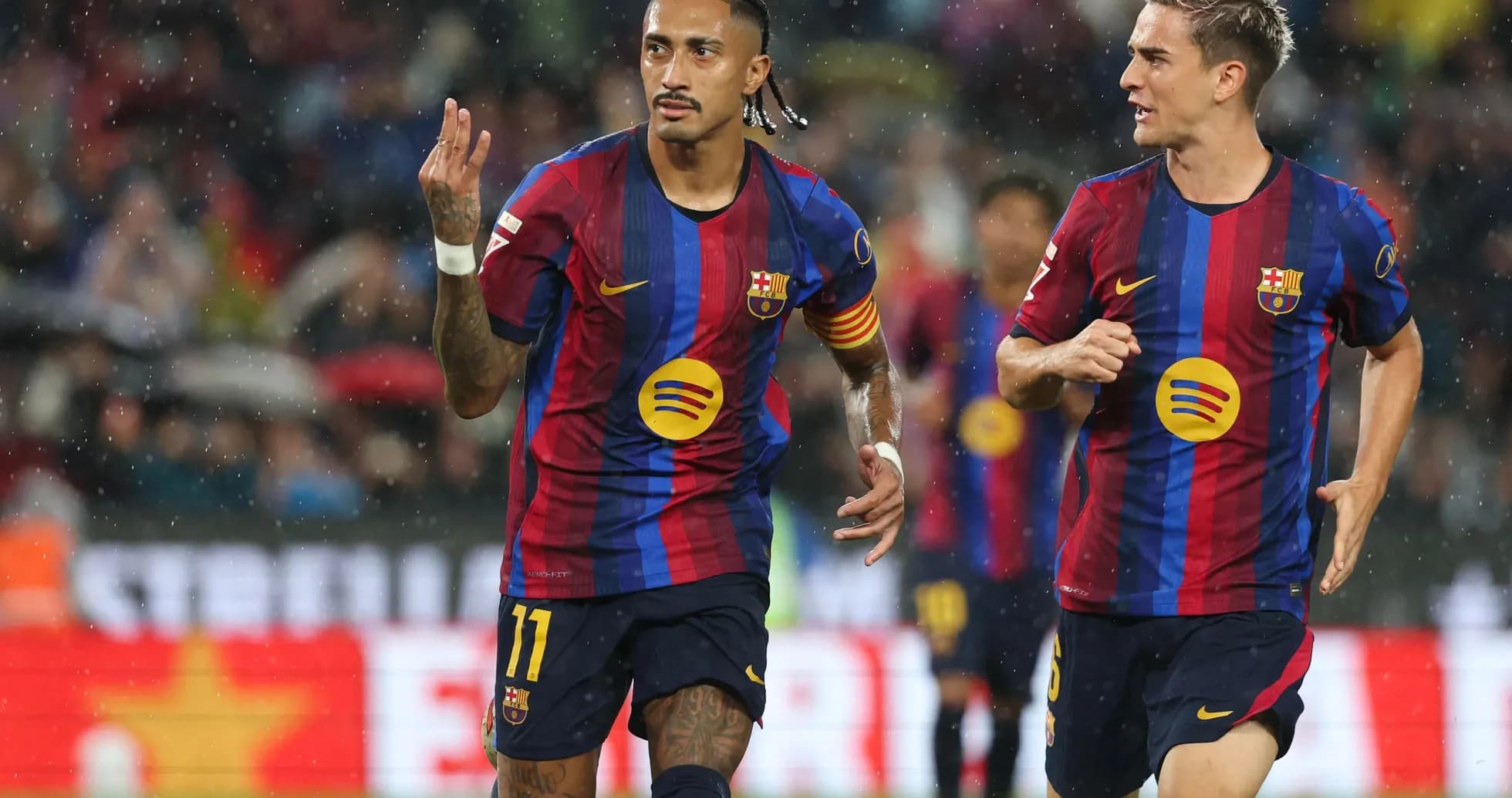
The breakthrough arrived early. On 9', Marcus Rashford (Barcelona) attacked from his left-sided midfield berth, exploiting the space between Trent Alexander-Arnold and Raúl Asencio. His “Normal Goal” set the tone: Barcelona’s wide midfielder driving into central finishing positions, supported by a compact block behind him.
On 18', Ferran Torres doubled the lead, finishing another “Normal Goal” after combining with Dani Olmo. Operating as the lone forward, Torres benefited from Olmo’s central positioning as a No. 10, receiving the assist from zone 14 and punishing Madrid’s retreating back line. At 2-0, Barcelona could recalibrate from all-out aggression to controlled dominance.
Disciplinary events, in strict chronological order:
- 40' Eduardo Camavinga (Real Madrid) — Foul
- 52' Dani Olmo (Barcelona) — Argument
- 52' Raúl Asencio (Real Madrid) — Foul
- 55' Jude Bellingham (Real Madrid) — Unallowed field entering
- 81' Raphinha (Barcelona) — Argument
- 81' Trent Alexander-Arnold (Real Madrid) — Argument
Totals: Barcelona: 2 yellow cards, Real Madrid: 4 yellow cards, Total: 6.
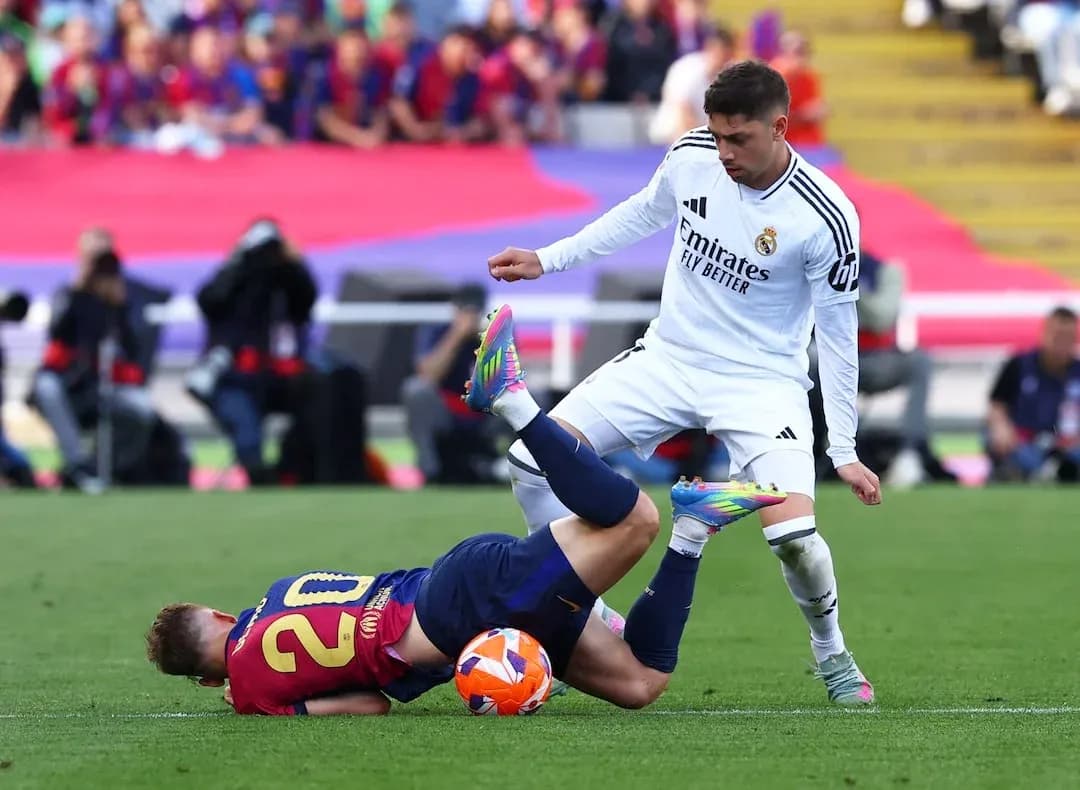
Camavinga’s 40' “Foul” card crystallised Madrid’s difficulties in screening central lanes against Pedri and Olmo. The cluster of “Argument” cards (Olmo, Raphinha, Alexander-Arnold) and Bellingham’s “Unallowed field entering” reflected frustration more than tactical aggression, as Madrid chased a game that Barcelona had already structurally locked.
Tactical Breakdown & Personnel
Flick’s 4-2-3-1 was clearly defined. Joan García in goal sat behind a back four of João Cancelo and Gerard Martín as full-backs, with Pau Cubarsí and Eric García central. Gavi and Pedri formed a double pivot, with Fermín López, Dani Olmo, and Marcus Rashford as the advanced three behind Ferran Torres.
In possession, Cancelo inverted frequently from the right, allowing Fermín López to occupy higher interior pockets, while Rashford stayed wide-left initially before underlapping. The first goal at 9' is consistent with this pattern: Rashford receiving with time to drive inside because Cancelo’s positioning drew Madrid’s right side narrower and higher. Torres’ 18' strike showcased how Olmo’s nominal No. 10 role became a second striker in the box, overloading Asencio and Antonio Rüdiger.
Out of possession, Barcelona’s 4-4-2 press emerged: Olmo stepped up alongside Torres, with Rashford and Fermín López flattening into a midfield line. Gavi and Pedri stayed tight to Bellingham and Brahim Díaz, preventing Madrid from progressing centrally. This structure limited Madrid to 8 total shots and just 1 on goal, despite 7 attempts inside the box — an indicator that Barcelona’s last-ditch defending and block density forced poor shot quality.
Real Madrid mirrored the 4-2-3-1: Thibaut Courtois in goal; a back four of Trent Alexander-Arnold, Raúl Asencio, Antonio Rüdiger, and Fran García; Camavinga and Aurélien Tchouaméni as the double pivot; Brahim Díaz, Jude Bellingham, and Vinicius Júnior behind Gonzalo García. Arbeloa’s idea was clear: Alexander-Arnold to provide width and delivery on the right, Vinicius to stretch on the left, with Bellingham attacking the half-spaces.
However, Madrid’s build-up repeatedly stalled. With Barcelona pressing high, Courtois was often forced long, bypassing the pivot. When Madrid did establish possession, Barcelona’s compact 4-2-3-1 denied Bellingham time between the lines, pushing Madrid toward wide crosses and second balls. The introduction of Thiago Pitarch for Camavinga on 70', Franco Mastantuono for Brahim Díaz, and César Palacios for Gonzalo García on 79' signalled a shift toward even more attacking risk, but did not materially change the chance quality.
Substitutions for Barcelona were primarily about energy management and preserving structure. On 64', Frenkie de Jong (IN) came on for Dani Olmo (OUT), adding press resistance in deeper zones as Barcelona moved into a more controlled, possession-oriented phase. Simultaneously, Raphinha (IN) came on for Marcus Rashford (OUT), maintaining vertical threat on the flank while offering fresher pressing legs. At 77', Robert Lewandowski (IN) came on for Ferran Torres (OUT), giving Barcelona a stronger reference point for long clearances and hold-up play, while Marc Bernal (IN) replaced Gavi (OUT) to sustain the double pivot’s intensity. Finally, at 88', Alejandro Balde (IN) came on for Fermín (OUT), adding defensive security on the flank to close out the game.
Courtois, despite conceding twice, recorded 5 goalkeeper saves, underlining Barcelona’s continued ability to generate on-target efforts even after easing off. Joan García made 1 save, reflecting how well his back line protected the box and limited Madrid to low-danger shots.
The Statistical Verdict
Barcelona’s statistical profile underpins the tactical story. They attempted 10 total shots with 7 on goal, from 0.99 xG, suggesting efficient shot selection and good finishing in the decisive early phase. Their passing game was elite: 527 passes, 484 accurate (92%), aligning with a possession share of 57%. This high “Overall Form” in possession combined with a strong “Defensive Index” — only 1 save required from Joan García and just 8 Madrid shots — shows a balanced, structurally sound performance.
Real Madrid produced 8 total shots but only 1 on goal, from 0.79 xG. Their 394 passes, 342 accurate (87%), and 43% possession show they were not overwhelmed territorially but were consistently pushed into less effective zones. The 8 corner kicks versus Barcelona’s 4 reflect late pressure and territorial gains, but without the central mechanisms to break a compact block.
Discipline tilted against Madrid: 4 yellow cards to Barcelona’s 2, all with specific reasons — “Foul”, “Argument”, and “Unallowed field entering” — mirroring a side chasing and increasingly frustrated. Combined with identical negative “goals prevented” values (-0.53 for each keeper), the numbers confirm a match where Barcelona’s early attacking clarity and structural control, rather than goalkeeping heroics or chaotic swings, decided the clásico.