Inside the Balotelli–Lambert Chaos at Liverpool
Rickie Lambert came back to Liverpool in 2014 with a point to prove. Mario Balotelli turned up the same summer and seemed determined to prove something entirely different.
One was the local lad coming home, desperate to show he belonged at Anfield after being released as a teenager. The other was already a global headline act, a walking circus of talent, controversy and shrugging indifference. Brendan Rodgers tried to bolt them together as part of a rebuilt attack in the post‑Luis Suárez era.
It did not take long for the fault lines to show.
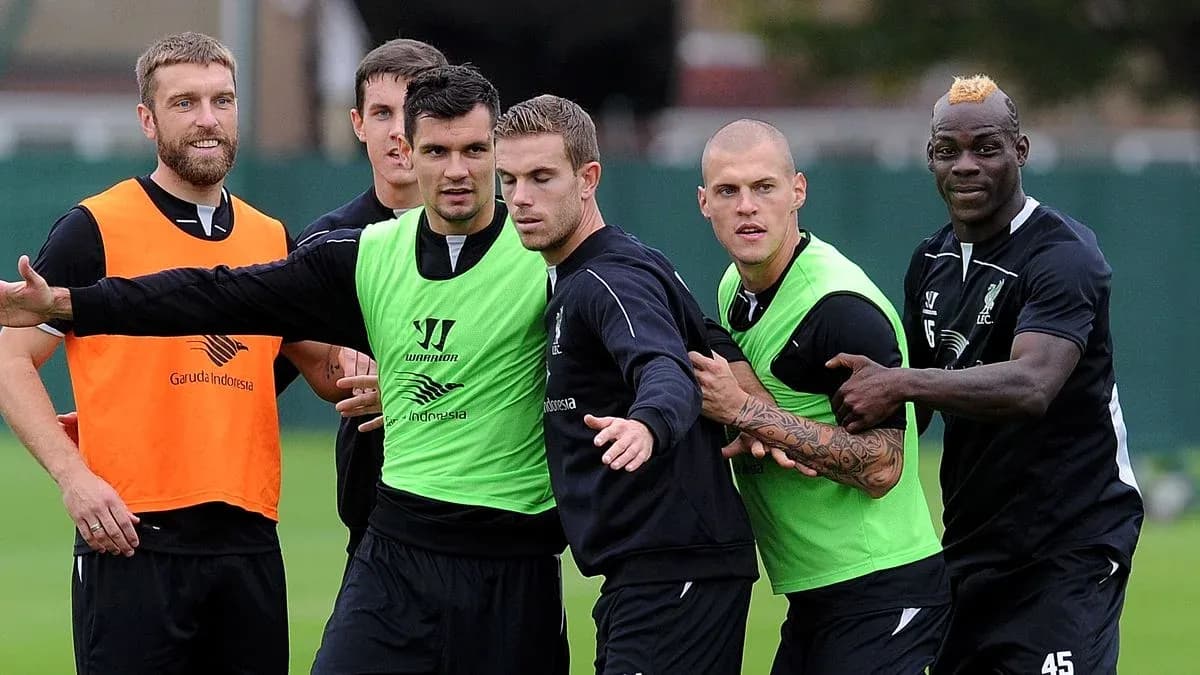
Lambert, speaking on the Straight From the Off podcast in 2021, painted a vivid picture of life alongside Balotelli on the training pitches at Melwood. Off the grass, he said, the Italian could be “a good lad, childish but infectious.” The mood changed the moment the bib went on.
“But as soon as he stepped on the training pitch he became a different person,” Lambert recalled. “I’ve never seen anything like it, to be honest.”
At first, Balotelli worked. When it mattered, when the whistle went on matchdays, Lambert felt he gave everything. Training was another world. Sessions became a battleground between Rodgers and his striker, with Balotelli answering the manager back and going through the motions.
Lambert admitted it ate away at him. He had fought his way up from the lower leagues, earned his dream move back to his boyhood club, and now found himself watching a teammate he felt was not fully invested – and still starting ahead of him.
“The fact that he was playing in front of me didn’t bother me at first, I thought ‘I’ll get myself in’,” Lambert said. “But just seeing the way he was in training, and then he was playing, it did affect me a little bit.”
Eventually, he snapped.
“My head went with him in training and I had to go in and say to Brendan, ‘Don’t put me on his team again’,” Lambert revealed. “I think Stevie [Gerrard] had said the same.”
The flashpoints were not just about attitude. They were about moments that left teammates stunned.
A report in The Standard in August 2015, just before Balotelli’s loan return to AC Milan, described one such incident. In a 10‑v‑10 training game, with Balotelli on the weaker side – largely made up of fringe players and substitutes ahead of a league clash with Arsenal – frustration boiled over.
The Italian picked up the ball around halfway and unleashed a “jaw‑dropping” strike. The technique was outrageous, the power pure Balotelli. Only one problem: he smashed it past his own goalkeeper, Brad Jones.
It was not a mishit clearance or a loose backpass. It was a deliberate, thunderous own goal that left onlookers and teammates astonished. For some, it was darkly comic. For others, trying to fight for minutes and careers, it was infuriating.
Episodes like that came to define Balotelli’s short, stuttering spell on Merseyside. The former Manchester City and Inter Milan forward arrived as a high‑risk gamble and never really caught fire. He scored just four goals in 28 appearances for Liverpool before being moved on to Nice in 2016, his time at Anfield reduced to a footnote in a career full of sharp peaks and long, chaotic troughs.
Lambert’s own Liverpool story never became the fairytale he wanted either. But his recollections strip away the myth and leave the reality of those months: a dressing room split between the grind of professionals clawing for opportunity and the unpredictable orbit of Mario Balotelli, a player whose refusal – or inability – to rein in his emotions shaped almost every chapter of his career.
At Liverpool, that clash of worlds played out on the training pitch, one outrageous own goal and one exasperated teammate at a time.