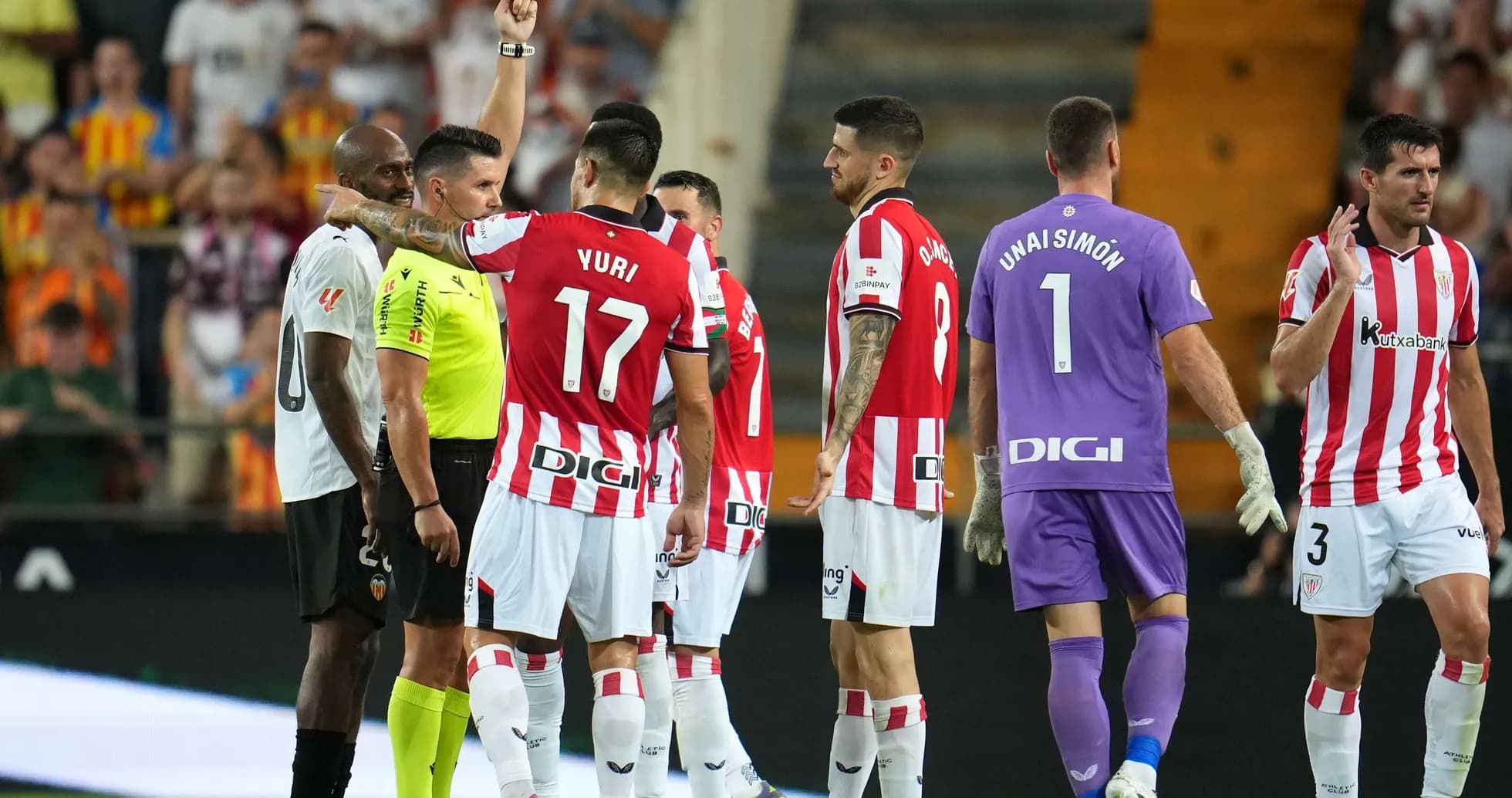
Athletic Club vs Valencia: A Tactical Battle in La Liga
San Mamés under grey Bilbao skies has seen its share of attritional La Liga battles, and this one fit the mould. Athletic Club, in their familiar 4-2-3-1 under Ernesto Valverde, were ground down 0-1 by a Valencia side that arrived as an away underdog but left with a clean sheet and three points. Following this result, the table tells of two mid-table sides—Athletic in 9th on 44 points with a goal difference of -11, Valencia in 12th on 42 and -12—whose identities are increasingly defined by fine margins rather than flourish.
I. The Big Picture – Two 4-2-3-1s, Two Different Stories
Both managers mirrored each other structurally. Athletic’s 4-2-3-1 was built on the ball-playing assurance of Unai Simón behind a back four of A. Gorosabel, Yeray Álvarez, Aymeric Laporte and Yuri Berchiche. In front, the double pivot of M. Jauregizar and A. Rego was tasked with knitting play and screening transitions, freeing a fluid band of three—R. Navarro, Oihan Sancet and Nico Williams—behind lone striker Gorka Guruzeta.
Valencia, nominally also in a 4-2-3-1, felt more like a compact 4-4-1-1 without the ball. S. Dimitrievski anchored a back line of Renzo Saravia, C. Tárrega, Eray Cömert and José Gayà. The double pivot of Pepelu and G. Rodríguez sat deep, with Diego López and Luis Rioja wide and Javi Guerra supporting Hugo Duro.
Heading into this game, the season data already hinted at a knife-edge contest. Overall, Athletic had scored 40 and conceded 51 across 35 matches, an average of 1.1 goals for and 1.5 against per game. At home, they had been marginally better defensively—20 conceded in 18 outings (1.1 per match)—and more productive going forward with 21 scored (1.2 per match). Valencia, meanwhile, had produced 38 goals and allowed 50 overall, averaging 1.1 for and 1.4 against. On their travels, their attack had been noticeably blunter at 0.8 goals per game (15 in 18), with 1.6 conceded on average (29 in 18). On paper, this was a fixture where Athletic’s home edge should have told; instead, it was Valencia’s defensive discipline that defined the afternoon.
II. Tactical Voids – Who Was Missing, and What It Meant
Athletic entered without several structural pillars. U. Egiluz (injury) and B. Prados Díaz (knee injury) removed depth and defensive security in midfield, while Iñigo Ruiz de Galarreta—one of La Liga’s most active midfield enforcers with 10 yellow cards and 58 tackles this season—was absent for personal reasons. His omission was particularly significant: Ruiz de Galarreta’s ability to disrupt, press and recycle would have been invaluable against Valencia’s double pivot. M. Sannadi was also unavailable by coach’s decision, narrowing Valverde’s options to change the rhythm from the bench.
Valencia were even more depleted in the defensive corridor. L. Beltrán (knee injury), J. Copete (ankle injury), M. Diakhaby (muscle injury), D. Foulquier (knee injury) and T. Rendall (muscle injury) all missed out, forcing Carlos Corberán to lean heavily on Cömert, Tárrega and Gayà to carry both defensive and build-up responsibilities. That they emerged with a clean sheet underlines the collective buy-in to a low-risk, compact game plan.
Disciplinary trends from the season framed the tone. Heading into this game, Athletic’s yellow-card distribution showed a clear spike between 61-75 minutes (22.37%) and a secondary surge in the 46-60 window (18.42%), often when they chase matches and press higher. Valencia’s bookings peaked even later, with 23.19% of their yellows arriving between 76-90 minutes, a sign of a side willing to foul to break rhythm in closing stages. The match duly followed that pattern: as Athletic pushed for an equaliser, Valencia leaned into tactical fouls and time management.
III. Key Matchups – Hunter vs Shield, Engine Room vs Enforcer
Without top-scorer data, the “Hunter vs Shield” battle was embodied more by roles than by numbers. Gorka Guruzeta led the line for an Athletic side that, at home, had averaged 1.2 goals per game but also failed to score in 5 of 18 outings. Against him stood a Valencia defence that, on their travels, had kept 5 clean sheets and conceded 29 goals—sturdy when protected by a low block.
Cömert and Tárrega handled Guruzeta by compressing the space between the lines, denying him the ability to receive on the half-turn. With Pepelu dropping into the back line in the first phase and G. Rodríguez screening, Valencia created a narrow central wall that forced Athletic to funnel attacks wide towards Nico Williams and R. Navarro. The Basques’ crossing game never quite found its range, and Dimitrievski’s command of the box neutralised the few clean deliveries that did arrive.
The “Engine Room” duel pivoted on Pepelu and Javi Guerra versus Athletic’s makeshift double pivot. Pepelu, calm in possession, orchestrated Valencia’s exits, while Guerra found pockets behind Jauregizar and Rego. Without Ruiz de Galarreta’s aggressive stepping into passing lanes—he has 18 interceptions and 48 fouls committed this season—Athletic’s midfield line often sat half a step too deep, allowing Valencia to progress methodically rather than under duress.
On the flanks, Luis Rioja’s season profile as a creative outlet came to the fore. Heading into this match, he had 6 assists, 35 key passes and 60 dribble attempts with 34 successes. His ability to carry the ball and draw fouls gave Valencia an outlet every time they weathered an Athletic wave. Against Gorosabel, Rioja repeatedly offered diagonal runs into the inside-left channel, forcing Yeray and the right-back into uncomfortable decisions: step out and leave space in behind, or hold the line and allow him to turn. That tension eventually contributed to the decisive moments that swung the game.
At the back, José Gayà was the embodiment of Valencia’s “Shield”. His season numbers—67 tackles, 7 blocked shots and 22 interceptions—explain why. Here, he balanced his forward surges with disciplined positioning against Nico Williams, rarely allowing the winger a pure 1v1 in isolation. Every time Williams looked to drive, Gayà’s timing in the tackle and support from Guerra or Pepelu smothered the danger.
IV. Statistical Prognosis – xG Tilt, but Valencia’s Structure Wins
While the raw xG figures are not provided, the season-long patterns allow a tactical inference. Athletic’s overall average of 1.1 goals for and 1.5 against, combined with 12 total matches where they failed to score, paints a picture of a side that often generates volume without consistent high-quality chances. Valencia, with 9 clean sheets overall and 5 away, are adept at turning games into low-xG, low-event contests.
Following this result, the narrative fits the data: Athletic likely edged territory and shot count, but too many of their attempts came from wide or distance, where xG values are modest. Valencia’s compact 4-2-3-1, dropping into a 4-4-1-1 without the ball, prioritised central protection and forced Athletic into predictable patterns. When their moment came—whether via a transition, a set piece, or a rare defensive lapse—they were clinical enough to convert one of their relatively few chances, a hallmark of a side comfortable operating on thin margins.
Defensively, Valencia’s away average of 1.6 goals conceded per match was bent but not broken. They reduced Athletic to one of those 12 total “failed to score” outings, underlining how structure and discipline can outweigh raw attacking intent. For Athletic, the absence of Ruiz de Galarreta in the engine room and the reliance on wide overloads without a true penalty-box predator left them short of ideas once the initial tempo faded.
In the end, this was a match where the tactical preview and the statistical profile converged: a tight, attritional contest in which the side with the clearer defensive identity and sharper exploitation of key moments—Valencia—emerged with a 1-0 victory and a statement away clean sheet at one of Spain’s most intimidating venues.