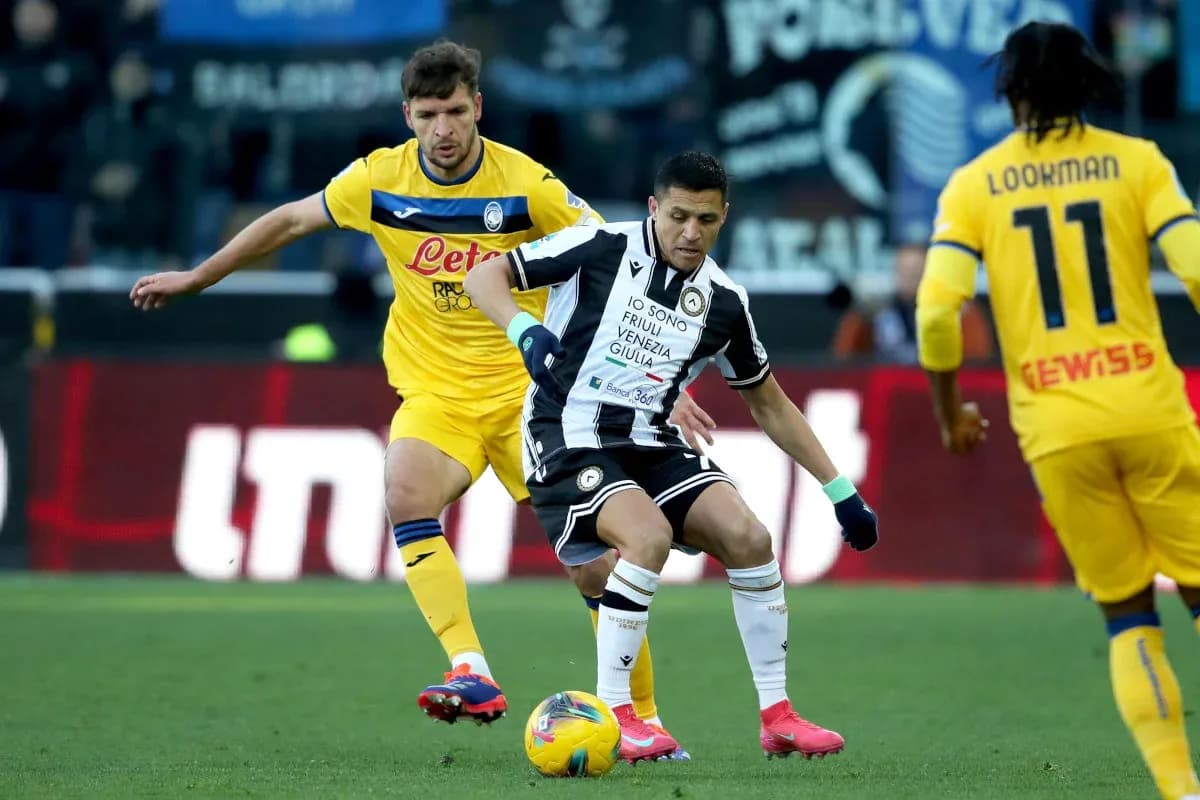
Atalanta Fights Back to Draw 2–2 with Udinese
Atalanta’s late surge salvaged a 2–2 draw against Udinese at the New Balance Arena on Saturday evening, but the point does little to change the broader picture for either side in Serie A. Seventh-placed Atalanta, on 46 points, dominated territorially yet needed a Gianluca Scamacca brace to claw back from 0–2 down. Udinese, 10th with 36 points, produced a ruthlessly efficient counter-attacking display and came within 15 minutes of a statement away win before being overwhelmed by sustained pressure.
First Half Analysis
Atalanta, in their familiar 3-4-2-1, immediately pushed high and hemmed Udinese into their own half, with Raoul Bellanova and Lorenzo Bernasconi stretching the pitch from wing-back. Udinese’s 3-5-2 responded by dropping Nicolò Zaniolo and Keinan Davis into deeper lanes, prioritising compactness over possession.
The early pattern was clear: Atalanta circulating the ball with patience, Udinese looking for direct breaks. The visitors’ resolve was first tested on 20', when Branimir Mlačić collected a yellow card for a foul, emblematic of the physical edge they were willing to bring to disrupt Atalanta’s rhythm.
Despite Atalanta’s territorial control and frequent entries into the box, clear chances were scarce. Udinese’s back three, anchored by Christian Kabasele and Thomas Kristensen, held the line well, forcing shots from distance and relying on disciplined midfield screening. The breakthrough, fittingly, went the other way. On 40', Udinese executed one of their rare forays with precision: Zaniolo found space to deliver and Kristensen arrived to score a goal from open play, giving the visitors a 1–0 lead at the interval and punishing Atalanta’s wastefulness.
Second Half & Tactical Shifts
Both coaches moved early after the restart. Atalanta made a structural tweak on 46' as Marten de Roon replaced Yunus Musah, adding more control and bite at the base of midfield. Udinese simultaneously withdrew the already-booked Mlačić, bringing on Oier Zarraga to stabilise their right side.
Instead of sparking an immediate Atalanta response, the second half initially deepened their problems. On 52', De Roon himself was booked for a foul, a sign of Atalanta’s increasing urgency and occasional frustration. Three minutes later, Udinese struck again. On 55', Davis capitalised on another incisive transition, finishing a goal from open play to make it 2–0 and momentarily silence the home crowd.
Gian Piero Gasperini (in effect, given Atalanta’s tactical identity) reacted with an aggressive triple change on 57': Nicola Zalewski came on for Odilon Kossounou, Davide Zappacosta replaced Bellanova, and Nikola Krstović took over from Lazar Samardžić. With a defender sacrificed for an extra attacking-minded wide player, it was a clear attacking gamble, pushing Atalanta into a more fluid, risk-heavy shape.
Udinese countered on 62' with a double switch of their own: Arthur Atta replaced Zaniolo, and Lennon Miller came on for Jakub Piotrowski, adding fresh legs in midfield to protect the lead. Maduka Okoye was then booked for time wasting on 66', underlining Udinese’s intent to manage the clock as much as the game.
The pressure eventually told. On 75', Scamacca halved the deficit, finishing from open play after smart work from Zalewski, whose introduction had injected more verticality and crossing quality on the left. Udinese responded by replacing Davis with Adam Buksa on 76', but the momentum had shifted decisively.
Just four minutes later, on 79', Scamacca struck again, this time without an assist, seizing on another attacking wave to level at 2–2. Udinese tried to refresh their left flank on 80' as Juan Arizala replaced Hassane Kamara, while Atalanta made a late defensive adjustment on 88', with Berat Djimsiti coming on for Sead Kolašinac to secure the point. The closing minutes saw Atalanta camped in Udinese territory, but without a decisive final touch to complete the comeback.
Statistical Deep Dive
The numbers underline Atalanta’s dominance and Udinese’s efficiency. Atalanta enjoyed 68% possession, circulating the ball through 601 passes with 506 completed at 84% accuracy. Udinese, with just 32% possession and 290 passes at 75% accuracy, conceded possession but focused on structural control and quick vertical attacks.
In terms of threat, Atalanta unleashed 22 shots, but only 4 were on target. Udinese’s defense, reflected by Atalanta’s 5 blocked efforts, repeatedly got bodies in the way at key moments. Udinese managed 8 shots with 2 on target, converting both to underline their clinical edge. The xG figures — 1.67 for Atalanta against Udinese’s 0.68 — align with the impression of a home side creating more but not quite at a level to justify a comfortable win.
Discipline also played a role in the match’s rhythm. Udinese committed 10 fouls and picked up two yellow cards (Mlačić for a foul, Okoye for time wasting), often breaking up Atalanta’s flow. Atalanta, with 7 fouls and a single booking for De Roon, were less frequent offenders but still had to walk a disciplinary tightrope in midfield.
Standings & Implications
For Atalanta, remaining on 46 points in 7th keeps them firmly in the European conversation but adds a sense of frustration; at home, with such territorial dominance, a draw feels like a missed opportunity to close the gap on those above. Udinese, on 36 points in 10th, will be satisfied with an away point against a top-seven side, especially given the context of leading 2–0. Their compact, counter-focused approach suggests a team capable of troubling stronger opponents, even if game management ultimately cost them all three points in Bergamo.