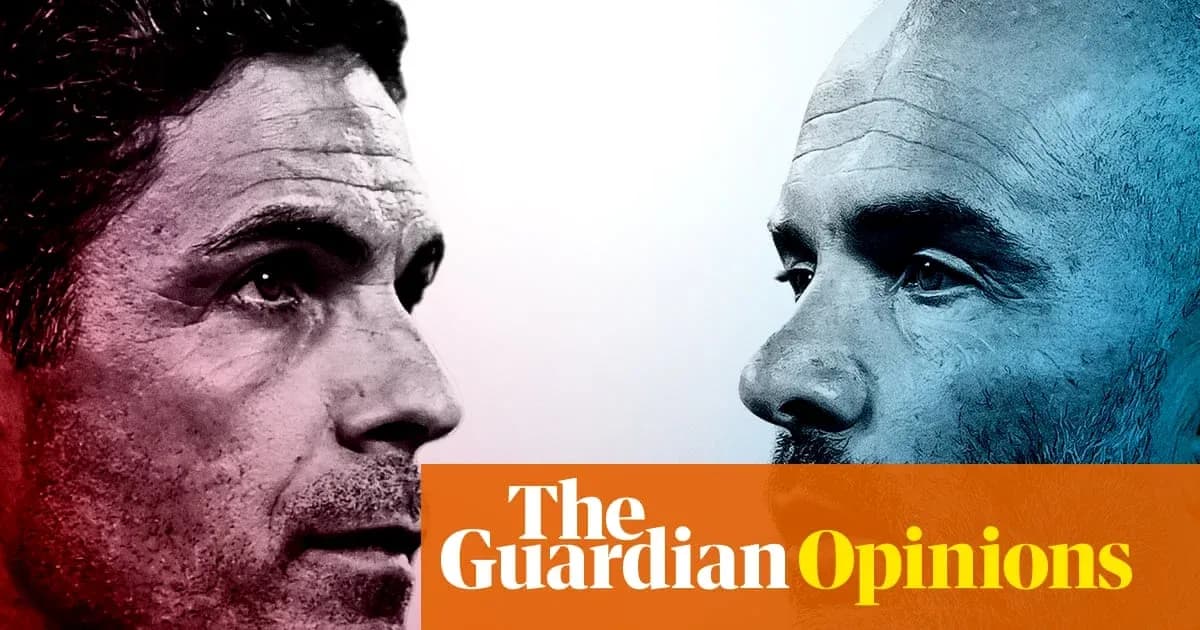
Arsenal's Hunger Test Against Manchester City's New Era
The question comes for every champion sooner or later. Are you still starving, or just comfortably full?
Arsenal have waited 22 years to find out. Two decades of near-misses, three consecutive seasons of finishing second, then finally the Premier League trophy in May, their 14th league title. The celebrations were wild, the release total. The cost, though, was obvious by the time the World Cup rolled around: Declan Rice running on fumes, Bukayo Saka drifting in and out of games, William Saliba breaking down with a back injury.
The body paid. So did the mind.
Now comes the strange part – the reset after a major tournament. Early weeks of a new season are usually scruffy, but this one feels especially volatile. Nine of the 20 Premier League clubs have changed manager. For the first time in 40 years, none of the era-defining figures – Sir Alex Ferguson, Arsène Wenger, José Mourinho, Jürgen Klopp or Pep Guardiola – stand on a Premier League touchline.
The league has lost its old guard. The landscape feels uncharted. Even at Arsenal, where Mikel Arteta is suddenly the longest-serving manager in the division, certainty is in short supply. A slow start would surprise nobody.
A new City, without their architect
On the other side of Sunday’s Community Shield, Manchester City arrive in a very different mood. Not broken, not in crisis, but bruised by two seasons that fell short of their own extraordinary standards and stripped of the man who built their modern identity.
Guardiola has gone. In his place, Enzo Maresca, a coach who looks and thinks like a Guardiola disciple because, for a key period, he was one.
Maresca brings a decent CV: he took Leicester up, then collected the Europa Conference League and Club World Cup with Chelsea. Yet those achievements never quite silenced the doubts. Leicester and Chelsea fans questioned the style, the tempo, the sense that he was squeezing everything out of the squads at his disposal. Chelsea’s squad issues were real, and they did slump badly after he left, but the feeling lingered that Maresca hadn’t fully cracked the puzzle.
Now he walks into a dressing room built for perfection, not patience. The questions are louder. The scrutiny will be relentless.
The Community Shield offers the first glimpse of what this new City might be. It will not give the full picture. It never does.
The anti-bellwether that still leaves a mark
Nobody should mistake this game for a title decider. The Shield is ceremonial, a curtain-raiser that flatters to deceive. Since 2018, no winner of the Community Shield has gone on to win the Premier League. In that sense it has become an anti-bellwether, a trophy that often hints at problems rather than confirming strength.
Its real value lies in hindsight. In 1974, a fight between Kevin Keegan and Billy Bremner turned a showpiece into a psychological X-ray. It revealed Keegan’s unease at Bill Shankly’s retirement and, more significantly, the deep malaise at Leeds United after Brian Clough replaced Don Revie.
In 2015, José Mourinho arrived for the Shield in tracksuit bottoms, baggy T‑shirt, unshaven, and then lost to Wenger for the first time. It looked like a curiosity. It turned out to be a warning. The season unravelled, the mood soured, and by December Mourinho was gone from Chelsea.
Last year, as Crystal Palace beat Liverpool on penalties after a 2-2 draw, the tells were everywhere for Arne Slot’s side. Mohamed Salah looked detached from the rest of the front line. The defence lurched from one lapse to the next, conceding two equalisers. The clues were there; the trick, as ever, was recognising what was teething trouble and what was structural decay.
This is the Shield’s habit. It rarely crowns the champion in August. It quietly points to what might break them in March.
Arsenal’s left flank, and a teenager in the spotlight
So what might Sunday actually reveal?
For Arsenal, the questions are more about nuance than overhaul. Bruno Guimarães, who came off the bench in Wednesday’s friendly against Como, could feature, likely alongside 19-year-old Myles Lewis-Skelly in midfield. The teenager has been a standout in pre-season while Rice, Martín Zubimendi and Martin Ødegaard enjoyed extended breaks after the World Cup.
Lewis-Skelly’s situation is complicated by links with a move away. That is why his celebration against Como – heart sign with his hands, a tap of the badge – felt like more than a routine pre-season flourish. It hinted at attachment, maybe at a decision. Maybe not. But it was noticed.
The left side of Arsenal’s attack is a more concrete issue. Leandro Trossard has been sold. Targets have slipped through their fingers: Morgan Rogers chose Chelsea, Vinícius Júnior stayed at Real Madrid. Arsenal did move for Christos Tzolis, the 24-year-old Greece international from Club Brugge, but nobody yet knows if he is the answer or just part of it.
Sunday will give the first real sense of how Tzolis fits into Arteta’s patterns. Does he hug the touchline and stretch teams, or drift inside and crowd the half-spaces Arsenal already love? Does he look like a starter, or like a squad option that still leaves a hole?
If Arsenal look blunt or predictable down that flank, the market will start whispering again.
City’s midfield ripped up and rewritten
City’s issues run deeper through the spine. The biggest cloud hangs over Rodri. His proposed move to Barcelona has not materialised, but the uncertainty lingers and City remain poised on the edge of a domino effect. If he goes, they move. If he stays, they may still need to reshape.
Enzo Fernández is the preferred candidate to anchor midfield if Rodri departs, yet questions about his physical profile will not go away. Can City really entrust the deepest role to a player whose game is built on rhythm and passing rather than power and reach, even with the arrival of the more robust Elliot Anderson?
Around that axis, the midfield is already being torn up. Tijjani Reijnders, who started friendlies against Inter and Atlético, is on his way to Al-Qadsiah. Bernardo Silva has joined Real Madrid. Those are not marginal exits; they are players who defined City’s control and creativity.
Where that leaves Phil Foden is one of the most intriguing subplots. Crowned player of the year in 2024, he has since stumbled for form. He did start against Inter and Atlético, a sign that Maresca still sees him as central, but the next few weeks – as World Cup returnees build fitness and competition intensifies – will tell us whether Foden can reassert himself as the heartbeat of a new City, or whether he drifts to the edges of the project.
Then there is John Stones. On the pitch, his departure may not transform City’s shape; he started only 11 games across the past two seasons. Inside the dressing room, it is different. Stones was a voice, a presence, a link to the Guardiola era. Remove him, remove Silva, remove Guardiola himself, and the character of the squad inevitably shifts.
We are about to find out what that looks like when the pressure is real.
A glimpse, not a verdict
So Sunday at Wembley becomes a peculiar kind of staging post. On one side, the champions who have finally climbed their mountain and must now prove they still crave the view. On the other, the serial winners stripped of their architect, trying to convince themselves that continuity can be rebuilt on the fly.
The Shield will not tell us who wins the league. It rarely does. What it can do is show where the cracks might appear when the strain builds.
For Arsenal, that might be the sharpness of their hunger, the balance of their left flank, the future of a teenager who looks ready but may not stay. For City, it might be the shape of a Rodri-less midfield, the weight on Fernández’s shoulders, the role of Foden, the personality of a dressing room without its old leaders.
Treat any conclusion with caution. But watch closely. In a Premier League stripped of its great managerial beasts, this is the first real look at what comes next.