AC Milan vs Atalanta: Tactical Analysis of a 3-2 Defeat
AC Milan’s 3-2 home defeat to Atalanta at Stadio Giuseppe Meazza unfolded as a structurally complex game: Allegri’s 3-5-2 was ripped open in transition early, then gradually imposed territorial and statistical control without ever fully neutralising Palladino’s 3-4-2-1 counter-punch. By full time of this Serie A Round 36 fixture, Milan’s 57% possession, 20 shots and higher xG (1.94 vs 1.08) told of a side structurally on top for long stretches but chasing a scoreboard shaped by Atalanta’s ruthless early efficiency.
I. Scoring sequence & disciplinary log
Atalanta struck first on 7', Ederson arriving from midfield to finish a move that exposed the gaps in Milan’s initial rest-defence. On 29', D. Zappacosta doubled the lead, exploiting space on the right and finishing from a Nikola Krstovic assist, sending Atalanta into a 0-2 half-time advantage that flattered them relative to volume of chances but reflected their superior exploitation of wide channels and Milan’s passive first-phase pressing.
The second half opened with aggressive changes from Allegri, but Atalanta landed what looked like a knockout blow on 51': G. Raspadori converted from an Ederson assist, capping a vertical transition to make it 0-3. Milan’s late tactical surge produced a response on 88', when centre-back S. Pavlovic scored from a S. Ricci assist, and the hosts added a 90' penalty converted by C. Nkunku for 2-3, but the damage from the first 60 minutes was decisive.
Disciplinary log (chronological, exact reasons):
- 34' Rafael Leão (AC Milan) — Foul
- 70' Isak Hien (Atalanta) — Argument
- 89' Adrien Rabiot (AC Milan) — Argument
- 89' Pervis Estupiñán (AC Milan) — Foul
- 90' Alexis Saelemaekers (AC Milan) — Argument
- 90+6' Raoul Bellanova (Atalanta) — Foul
- 90+5' Nikola Krstović (Atalanta) — Time wasting
Card totals: AC Milan 4, Atalanta 3, Total: 7.
II. Tactical breakdown & personnel
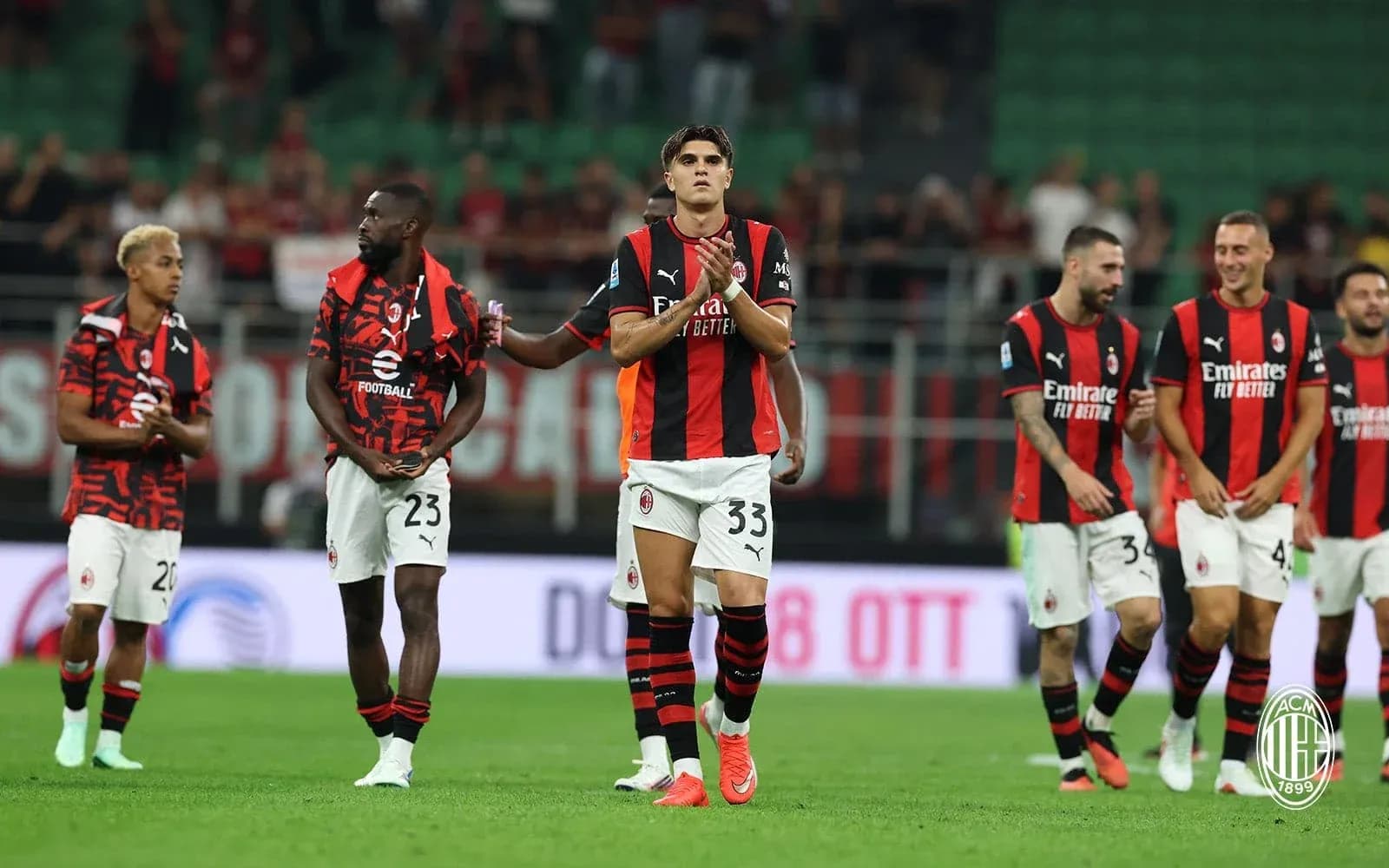
Allegri’s 3-5-2 with M. Maignan behind a back three of K. De Winter, M. Gabbia and S. Pavlovic aimed to control central zones and push wing-backs A. Saelemaekers and D. Bartesaghi high. The double pivot of S. Ricci and Adrien Rabiot, with R. Loftus-Cheek as the advanced interior, was designed to feed a front two of S. Gimenez and Rafael Leão. On paper, Milan’s structure should have provided strong rest-defence; in practice, early distances between the back three and midfield were too large, allowing Ederson and G. Raspadori to receive between the lines and trigger Atalanta’s vertical attacks.
Palladino’s 3-4-2-1 was classic Atalanta: M. Carnesecchi behind G. Scalvini, Isak Hien and S. Kolasinac, with D. Zappacosta and N. Zalewski as aggressive wing-backs. M. De Roon and Ederson formed a compact central screen, while C. De Ketelaere and G. Raspadori floated behind Nikola Krstovic. Their early game-plan was clear: soak pressure in a mid-block, then hit quickly into the channels behind Milan’s wing-backs. The first two goals came precisely from these patterns, with Zappacosta and Ederson exploiting Milan’s slow backward transition.
In goal, Maignan registered 2 saves against Atalanta’s 5 shots on target and 1.08 xG. The “goals prevented” figure of 1.1 suggests that, despite conceding three, his shot-stopping actually kept the scoreline from being worse, implying Atalanta’s chances were high quality relative to volume. At the other end, Carnesecchi made 8 saves from 9 shots on target against 1.94 xG, also with 1.1 goals prevented. That combination — Milan generating nearly twice the xG but losing — underlines how Carnesecchi’s performance and Atalanta’s compact box defending were decisive.
Allegri’s substitutions were structurally aggressive. At 46', C. Nkunku (IN) came on for R. Loftus-Cheek (OUT), effectively shifting Milan towards a more direct, forward-heavy shape with Nkunku operating between the lines. On 58', Z. Athekame (IN) replaced K. De Winter (OUT) and N. Fullkrug (IN) came on for S. Gimenez (OUT), adding aerial presence and fresh legs in the back line. Simultaneously, Y. Fofana (IN) replaced R. Leao (OUT), a move that traded Leão’s 1v1 threat for more central dynamism and pressing. At 80', P. Estupinan (IN) for D. Bartesaghi (OUT) brought fresh energy down the left, but also contributed to Milan’s late disciplinary issues.
Palladino’s changes were more about game-state management. O. Kossounou (IN) replaced G. Scalvini (OUT) on 48', maintaining the back-three structure while refreshing defensive legs. On 55', R. Bellanova (IN) for D. Zappacosta (OUT) preserved the wing-back profile but added pace for counters. The 63' window saw H. Ahanor (IN) for an unnamed player and M. Pasalic (IN) for C. De Ketelaere (OUT), shifting Atalanta towards a more conservative, box-protecting 3-5-1-1. As Milan’s pressure mounted, Atalanta’s yellow cards — particularly Hien’s “Argument” on 70' and Krstović’s “Time wasting” on 90+5' — reflected a side increasingly focused on preserving the lead rather than expanding it.
III. The statistical verdict
Milan’s 57% possession and 541 passes, 478 accurate (88%), show a side that ultimately controlled the ball and territory. Atalanta’s 43% possession with 411 passes, 330 accurate (80%), aligns with a reactive, transition-oriented approach. Shot volume heavily favoured Milan: 20 total shots (9 on goal) to Atalanta’s 9 (5 on goal), with Milan more willing to shoot from distance (12 outside the box) while Atalanta concentrated their threat inside the area (7 shots in the box).
Defensively, Milan committed only 8 fouls to Atalanta’s 17, but accumulated more yellow cards (4 vs 3), with three of Milan’s bookings (Rabiot, Saelemaekers, and Leão) linked to “Argument” or emotional moments rather than purely tactical fouling. Atalanta’s cards were more functional: Hien and Bellanova for “Foul” and “Argument”, Krstović for “Time wasting”, consistent with a side under late siege protecting a narrow lead.
The xG split — Milan 1.94, Atalanta 1.08 — combined with identical goals prevented (1.1 each) underlines the tactical story: Milan’s overall form in possession and chance creation was superior, but Atalanta’s defensive index, compactness in their box, and clinical early transitions produced a result that their raw attacking volume alone would not predict. Milan’s late tactical push turned a potential rout into a narrow 2-3 defeat, yet the structural vulnerabilities of their first hour ultimately defined the night.